127 posters, 2 topics, 24 sessions, 326 authors, 85 institutions
ePostersLive by SciGen Technologies S.A. All rights reserved.
2023 ACP ANNUAL SESSION
October 25-28 | San Diego, CA
124
Comparative Analysis of Student Satisfaction with Conventional and Digital Denture Fabrication Protocols: Addressing Educational Barriers through Curriculum Enhancement
Poster Presenter
Authors
Leela Breitman, Wendy Clark, Soni Prasad, David Felton, Paul Kuta
Affiliations
Part of Topic
Original Research
Introduction
With the increasing adoption of digital workflows in removable prosthodontics, dental educators are working to incorporate and expand digital learning into prosthodontic predoctoral curricula.1 Broadly speaking, curricula on digital denture fabrication are less developed than are those for conventional denture fabrication.2,3 This is due, in part, to the fact that digital denture protocols are relatively new compared to those for the fabrication of complete dentures through conventional protocols. This study aimed to assess student satisfaction with existing complete denture curricula to understand how to bridge educational gaps between conventional and digital denture fabrication protocols for future curriculum development.
Methods
An IRB-exempt (UNC IRB 20-2218) study was conducted at the UNC Adam’s School of Dentistry. The study was conducted among second year predoctoral dental students as part of their didactic and preclinical course on Complete Dentures (DENT212). Following lecture presentations from subject matter experts on conventional and digital complete denture fabrication workflows, students participated in practical exercises on digital tooth arrangement (DentcaTM Academy) and conventional tooth arrangement (IvoclarTM Academy).
After completing the DENT212 course, a survey was distributed to second year students (n=85) via QualtricsTM , evaluating students’ satisfaction with the conventional and digital denture exercises and curricula on tooth arrangement. The null hypothesis posited no difference in students’ satisfaction between the two modalities.
Results
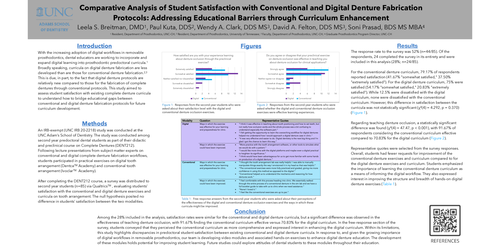
The response rate to the survey was 52% (n=44/85). Of the respondents, 24 completed the survey in its entirety and were included in this analysis (28%; n=24/85).
For the conventional denture curriculum, 79.17% of respondents reported satisfaction (41.67% "somewhat satisfied," 37.50% "extremely satisfied"). For the digital denture curriculum, 75% were satisfied (54.17% "somewhat satisfied," 20.83% "extremely satisfied”). While 12.5% were dissatisfied with the digital curriculum, none were dissatisfied with the conventional curriculum. However, this difference in satisfaction between the curricula was not statistically significant (χ²(4) = 4.292, p = 0.370) (Figure 1).
Regarding teaching denture occlusion, a statistically significant difference was found (χ²(4) = 47.47, p < 0.001), with 91.67% of respondents considering the conventional curriculum effective compared to 70.83% for the digital curriculum (Figure 2).
Representative quotes were selected from the survey responses. Overall, students had fewer requests for improvement of the conventional denture exercises and curriculum compared to for the digital denture exercises and curriculum. Students emphasized the importance of learning the conventional denture curriculum as a means of informing the digital workflow. They also expressed interest in improving the structure and breadth of hands-on digital denture exercises (Table 1).
Conclusion
Among the 28% included in the analysis, satisfaction rates were similar for the conventional and digital denture curricula, but a significant difference was observed in the effectiveness of teaching denture occlusion, with 91.67% finding the conventional curriculum effective versus 70.83% for the digital curriculum. In the free-response section of the survey, students conveyed that they perceived the conventional curriculum as more comprehensive and expressed interest in enhancing the digital curriculum. Within its limitations, this study highlights discrepancies in predoctoral student satisfaction between existing conventional and digital denture curricula. In response to, and given the growing importance of digital workflows in removable prosthodontics, our team is developing video modules and associated hands-on exercises to enhance digital denture education. The development of these modules holds potential for improving student learning. Future studies could explore attitudes of dental students to these modules throughout their education.