105 posters, 2 topics, 24 sessions, 264 authors, 71 institutions
ePostersLive by SciGen Technologies S.A. All rights reserved.
2022 ACP Annual Session
2 - 5 November | Austin, TX

98
The Effect of Multiple Heat Treatment Cycles on the Translucency of a Nano- Lithium Disilicate CAD/CAM Material
Poster Presenter
Authors
Affiliations
Part of Topic
Original Research
The Effect of Multiple Heat Treatment Cycles on the Translucency of a Nano Lithium Disilicate CAD/CAM Material
Heidar O Shahin , Evangelia Gkoulitou, Amir H Nejat
Department of Prosthodontics, Louisiana State University School of Dentistry, New Orleans, LA
introduction: A nano lithium disilicate CAD/CAM block is available with the capability to provide different levels of translucency in a single block through different heat treatment cycle.
The objective of this research was to evaluate the effect of multiple heat treatment cycles on the translucency of a nano lithium disilicate CAD/CAM material
Methods:
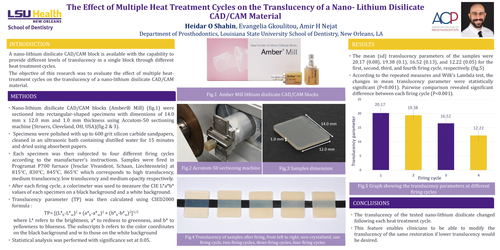
Nano lithium disilicate CAD/CAM blocks (Amber® Mill)Mill)(fig 1 were sectioned into rectangular shaped specimens with dimensions of 14 0 mm x 12 0 mm and 1 0 mm thickness using Accutom 50 sectioning machine Struers Cleveland, OH, USA)(fig 2 3
• Specimens were polished with up to 600 grit silicon carbide sandpapers, cleaned in an ultrasonic bath containing distilled water for 15 minutes and dried using absorbent papers
• Each specimen was then subjected to four different firing cycles according to the manufacturer's instructions Samples were fired in Programat P 700 furnace (Ivoclar Vivandent Schaan Liechtenstein) at 815 830 845 865 which corresponds to high translucency, medium translucency, low translucency and medium opacity respectively
• After each firing cycle, a colorimeter was used to measure the CIE L*a*b* values of each specimen on a black background and a white background
• Translucency parameter (TP) was then calculated using CIED 2000 formula
TP= [(L*b-L*w)2 + (a*b-a*w)2 + (b*b-b*w)2]1/2
where L* refers to the brightness, a* to redness to greenness, and b* to yellowness to blueness. The subscripts b refers to the color coordinates on the black background and w to those on the white background.
• Statistical analysis was performed with significance set at 0.05
results:
The mean (sd) translucency parameters of the samples were 20.17 (0.08), 19.38 (0.1), 16.52 (0.13), and 12.22 (0.05) for the first, second, third, and fourth firing cycle, respectively. (fig.5)
According to the repeated measures and Wilk’s Lambda test, the changes in mean translucency parameter were statistically significant (P<0.001). Pairwise comparison revealed significant difference between each firing cycle (P<0.001).
conclusions: