105 posters, 2 topics, 24 sessions, 264 authors, 71 institutions
ePostersLive by SciGen Technologies S.A. All rights reserved.
2022 ACP Annual Session
2 - 5 November | Austin, TX

111
Fracture Toughness of Water-immersed, Milled Monolithic Denture Bases
Poster Presenter
Authors
Shazeen Rattansi, Parker Blincoe, Geoff Sheen, Don Mettenburg, Frederick Rueggeberg
Affiliations
Part of Topic
Original Research
Fracture Toughness of Water-immersed, Milled Monolithic Denture Bases
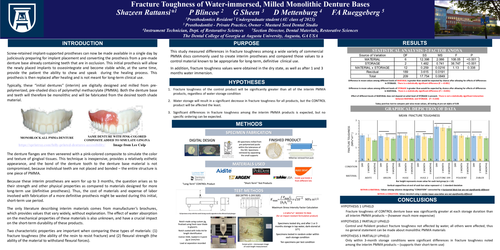
Screw-retained implant-supported prostheses can now be made available in a single day by judiciously preparing for implant placement and converting the prosthesis from a pre-made denture base already containing teeth that are in occlusion. This initial prosthesis will allow the newly placed implants to osseointegrate and become stable while, at the same time, provide the patient the ability to chew and speak during the healing process. This prosthesis is then replaced after healing and is not meant for long-term clinical use.
Typically, these “initial dentures” (interim) are digitally designed and milled from pre-polymerized, pre-shaded discs of polymethyl methacrylate (PMMA). Both the denture base and teeth will therefore be monolithic and will be fabricated from the desired tooth shade material.
The denture flanges are then veneered with a pink-colored composite to simulate the color and texture of gingival tissues. This technique is inexpensive, provides a relatively esthetic appearance, and the bond of the denture tooth to the denture base material is not compromised, because individual teeth are not placed and bonded – the entire structure is one piece of PMMA.
Because these interim prostheses are worn for up to 3 months, the question arises as to their strength and other physical properties as compared to materials designed for more long-term use (definitive prostheses). Thus, the cost of materials and expense of labor involved with fabrication of a more definitive prosthesis might be wasted during this initial, short-term use period.
The only literature describing interim materials comes from manufacturer’s brochures, which provides values that vary widely, without explanation. The effect of water absorption on the mechanical properties of these materials is also unknown, and have a crucial impact on the short-term durability of these products.
Two characteristic properties are important when comparing these types of materials: (1) fracture toughness (the ability of the resin to resist fracture) and (2) flexural strength (the ability of the material to withstand flexural forces).