105 posters, 2 topics, 24 sessions, 264 authors, 71 institutions
ePostersLive by SciGen Technologies S.A. All rights reserved.
2022 ACP Annual Session
2 - 5 November | Austin, TX

105
Electronic Jaw Tracking Device: Literature Review.
Poster Presenter
Authors
Affiliations
Part of Topic
Original Research
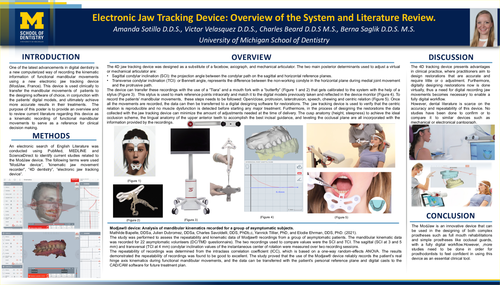
One of the latest advancements in digital dentistry is a new computerized way of recording the kinematic information of functional mandibular movements using a new electronic jaw tracking device (ModJaw, France). This device is used clinically to transfer the mandibular movements of patients to the designing software of choice, in conjunction with the patients’ digital models, and ultimately achieve more accurate results in their treatments. The purpose of this poster is to provide an overview and to review current literature regarding this device as a kinematic recording of functional mandibular movements to serve as a reference for clinical decision making.
An electronic search of English Literature was conducted using PubMed, MEDLINE and ScienceDirect to identify current studies related to the ModJaw device. The following terms were used “ModJAw device”, “kinematic jaw movement recorder”, “4D dentistry”, ”electronic jaw tracking device”.
An electronic search of English Literature was conducted using PubMed, MEDLINE and ScienceDirect to identify current studies related to the ModJaw device. The following terms were used “ModJAw device”, “kinematic jaw movement recorder”, “4D dentistry”, ”electronic jaw tracking device”.
The 4D jaw tracking device was designed as a substitute of a facebow, axiograph, and mechanical articulator. The two main posterior determinants used to adjust a virtual or mechanical articulator are:
- Sagittal condylar inclination (SCI): the projection angle between the condylar path on the sagittal and horizontal reference planes.
- Transverse condylar inclination (TCI): or Bennett angle, represents the difference between the non-working condyle in the horizontal plane during medial joint movement and the protrusive path.
The device can transfer these recordings with the use of a “Tiara” and a mouth fork with a “butterfly” (Figure 1 and 2) that gets calibrated to the system with the help of a stylus (Figure 3). This stylus is used to mark reference points intraorally and match it to the digital models previously taken and reflected in the device monitor (Figure 4). To record the patients' mandibular movements, these steps needs to be followed: Open/close, protrusion, laterotrusion, speech, chewing and centric relation (Figure 5). Once all the movements are recorded, the data can then be transferred to a digital designing software for restorations. The jaw tracking device is used to verify that the centric relation is reproducible and no muscle dysfunction is detected before starting any major treatment. Furthermore, in the process of designing the restorations the data collected with the jaw tracking device can minimize the amount of adjustments needed at the time of delivery. The cusp anatomy (height, steepness) to achieve the ideal occlusion scheme, the lingual anatomy of the upper anterior teeth to accomplish the best incisal guidance, and leveling the occlusal plane are all incorporated with the information provided by the recordings.
Modjaw® device: Analysis of mandibular kinematics recorded for a group of asymptomatic subjects.
Mathilde Bapelle, DDSa, Julien Dubromez, DDSa, Charles Savoldelli, DDS, PhDb,c, Yannick Tillier, PhD, and Elodie Ehrman, DDS, PhD. (2021).
The study was performed to assess the repeatability and kinematic data of Modjaw® recordings from a group of asymptomatic patients. The mandibular kinematic data was recorded for 22 asymptomatic volunteers (DC/TMD questionnaire). The two recordings used to compare values were the SCI and TCI. The sagittal (SCI at 3 and 5 mm) and transversal (TCI at 4 mm) condylar inclination values of the instantaneous center of rotation were measured over two recording sessions.
The repeatability of recordings was determined from the intraclass correlation coefficient (ICC), which is based on a one-way random-effects ANOVA. The results demonstrated the repeatability of recordings was found to be good to excellent. The study proved that the use of the Modjaw® device reliably records the patient’s real hinge axis kinematics during functional mandibular movements, and the data can be transferred with the patient’s personal reference plane and digital casts to the CAD/CAM software for future treatment plan.
The 4D tracking device presents advantages in clinical practice, where practitioners aim to design restorations that are accurate and require little or o adjustment. Furthermore, digitally designing restorations now is done virtually, thus a need for digital recording jaw movements becomes necessary to enable a fully digital workflow.
However, dental literature is scarce on the accuracy and repeatability of this device. No studies have been done to confirm or to compare it to similar devices such as mechanical or electronical pantograph.
The ModJaw is an innovative device that can be used in the designing of both complex prostheses such as full mouth rehabilitations and simple prostheses like occlusal guards, with a fully digital workflow.However, ,more studies need to be done in order for prosthodontists to feel confident in using this device as an essential clinical tool
|
.