105 posters, 2 topics, 24 sessions, 264 authors, 71 institutions
ePostersLive by SciGen Technologies S.A. All rights reserved.
2022 ACP Annual Session
2 - 5 November | Austin, TX

95
THE DIFFERENCE IN FRACTURE STRENGTH OF TRANSLUCENT ZIRCONIA (5Y-Z) USING DIFFERENT CEMENTS AND SURFACE TREATMENTS
Poster Presenter
Part of Topic
Original Research
The Difference In Fracture Strength Of Translucent Zirconia (5Y-Z)
Using Different Cements And Surface Treatments
E Elamin ,D Givan , N Lawson ,W Wu,C Fu
University of Alabama at Birmingham
With the recent advent of translucent and ultra-translucent zirconia, it remains unclear if adhesive cementation and different surface treatment will affect the fracture strength of this type of ceramic restorations
The purpose of this study is to investigate the fracture strength of translucent zirconia (5Y-Z) using different crown thickness, different cements under different surface treatment conditions.
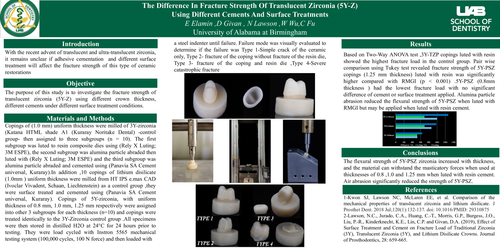
Copings of (1.0 mm) uniform thickness were milled of 3Y-zirconia (Katana HTML shade A1 (Kuraray Noritake Dental) -control group- then assigned to three subgroups (n = 10). The first subgroup was luted to resin composite dies using (Rely X Luting; 3M ESPE), the second subgroup was alumina particle abraded then luted with (Rely X Luting; 3M ESPE) and the third subgroup was alumina particle abraded and cemented using (Panavia SA Cement universal, Kuraray).In addition ,10 copings of lithium disilicate (1.0mm ) uniform thickness were milled from HT IPS e.max CAD (Ivoclar Vivadent, Schaan, Liechtenstein) as a control group ,they were surface treated and cemented using (Panavia SA Cement universal, Kuraray). Copings of 5Y-zirconia, with uniform thickness of 0.8 mm, 1.0 mm, 1.25 mm respectively were assigned into other 3 subgroups for each thickness (n=10) and copings were treated identically to the 3Y-Zirconia control group
All specimens were then stored in distilled H2O at 24°C for 24 hours prior to testing. They were load cycled with Instron 5565 mechanical testing system (100,000 cycles, 100 N force) and then loaded with a steel indenter until failure. Failure mode was visually evaluated to determine if the failure was Type 1-Simple crack of the ceramic only, Type 2- fracture of the coping without fracture of the resin die, Type 3- fracture of the coping and resin die ,Type 4-Severe catastrophic fracture
Based on Two-Way ANOVA test ,3Y-TZP copings luted with resin showed the highest fracture load in the control group. Pair wise comparison using Tukey test revealed fracture strength of 5Y-PSZ copings (1.25 mm thickness) luted with resin was significantly higher compared with RMGI (p < 0.001) .5Y-PSZ (0.8mm thickness ) had the lowest fracture load with no significant difference of cement or surface treatment applied. Alumina particle abrasion reduced the flexural strength of 5Y-PSZ when luted with RMGI but may be applied when luted with resin cement.
The flexural strength of 5Y-PSZ zirconia increased with thickness, and the material can withstand the masticatory forces when used at thicknesses of 0.8 ,1.0 and 1.25 mm when luted with resin cement. Air abrasion significantly reduced the strength of 5Y-PSZ
1-Kwon SJ, Lawson NC, McLaren EE, et al. Comparison of the mechanical properties of translucent zirconia and lithium disilicate. J Prosthet Dent. 2018 Jul;120(1):132-137. doi: 10.1016/PMID: 29310875
2-Lawson, N.C., Jurado, C.A., Huang, C.‐T., Morris, G.P., Burgess, J.O., Liu, P.‐R., Kinderknecht, K.E., Lin, C.P. and Givan, D.A. (2019), Effect of Surface Treatment and Cement on Fracture Load of Traditional Zirconia (3Y), Translucent Zirconia (5Y), and Lithium Disilicate Crowns. Journal of Prosthodontics, 28: 659-665.