105 posters, 2 topics, 24 sessions, 264 authors, 71 institutions
ePostersLive by SciGen Technologies S.A. All rights reserved.
2022 ACP Annual Session
2 - 5 November | Austin, TX

79
Comparison of accuracy in digital and conventional cross-mounting
Poster Presenter
Authors
Affiliations
Part of Topic
Original Research
COMPARISON OF ACCURACY IN DIGITAL AND CONVENTIONAL CROSS-MOUNTING
Dianne Luu DMD, Elena Kan DDS, Soo-Woo Kim DMD DMSc, Jason D Lee DDS MMSc, Sang J Lee DMD MMSc
Department of Restorative Dentistry and Biomaterial Sciences, Harvard School of Dental Medicine, Boston, MA, USA
BACKGROUND
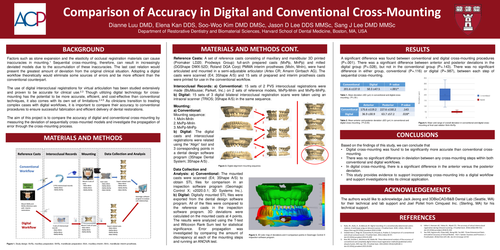
Factors such as stone expansion and the elasticity of occlusal registration materials can cause inaccuracies in mounting.1 Sequential cross-mounting, therefore, can result in increasingly deviated models due to the accumulation of these inaccuracies. The last cast relation would present the greatest amount of deviation from the original clinical situation. Adopting a digital workflow theoretically would eliminate some sources of errors and be more efficient than the conventional counterpart.
The use of digital interocclusal registrations for virtual articulation has been studied extensively and proven to be accurate for clinical use.2,3 Though utilizing digital technology for cross-mounting has the potential to be more accurate, efficient, and cost-effective than conventional techniques, it also comes with its own set of limitations.2,4,5 As clinicians transition to treating complex cases with digital workflows, it is important to compare their accuracy to conventional procedures to ensure successful fabrication and efficient delivery of dental restorations.
The aim of this project is to compare the accuracy of digital and conventional cross-mounting by measuring the deviation of sequentially cross-mounted models and investigate the propagation of error through the cross-mounting process.
MATERIALS AND METHODS
Reference Casts: A set of reference casts consisting of maxillary and mandibular 3D printed (Promaker LD20; Prodways Group) full-arch prepared casts (MxPp, MnPp) and milled (DGShape DWX-52D; Roland DGA Corp) PMMA interim prostheses (MxIn, MnIn), were hand articulated and mounted in a semi-adjustable articulator (Artex CR; Amann Girrbach AG). The casts were scanned (E4; 3Shape A/S) and 15 sets of prepared and interim prosthesis casts were printed for use in the conventional workflow.
Interocclusal Records: a) Conventional: 15 sets of 2 PVS interocclusal registrations were made (BluMousse; Parkell, Inc.) on 2 sets of reference models, MxPp-MnIn and MxPp-MnPp.
b) Digital: 15 sets of 3 digital bilateral interocclusal registration scans were taken using an intraoral scanner (TRIOS; 3Shape A/S) in the same sequence.
Mounting:
a) Conventional:
Mounting sequence:
1.MxIn-MnIn
2.MxPp-MnIn
3.MxPp-MnPp
b) Digital: The digital casts and interocclusal registrations were related using the “Align” tool and 3 corresponding points in a dental design software program (3Shape Dental System; 3Shape A/S) .
Data Collection and Analysis:
a) Conventional: The mounted casts were scanned (E4; 3Shape A/S) to obtain STL files for comparison in an inspection software program (Geomagic Control X; v2020.0.1; 3D Systems Inc.).
b) Digital: Digitally mounted STL files were exported from the dental design software program. All of the files were compared to the reference casts in the inspection software program. 3D deviations were calculated on the mounted casts at 4 points. The results were analyzed using the T-test and Wilcoxon Rank Sum test for statistical significance. Error propagation was investigated by comparing the amount of discrepancy at each of the mounting steps and running an ANOVA test.
RESULTS
A significant difference was found between conventional and digital cross-mounting procedures (P<.001). There was a significant difference between anterior and posterior deviations in the digital group (P=.028), but not in the conventional group (P=.143). There was no significant difference in either group, conventional (P=.116) or digital (P=.987), between each step of sequential cross-mounting.
CONCLUSIONS
Based on the findings of this study, we can conclude that
•Digital cross-mounting was found to be significantly more accurate than conventional cross-mounting.
•There was no significant difference in deviation between any cross-mounting steps within both conventional and digital workflows.
•In digital cross-mounting, there is a significant difference in the anterior versus the posterior deviation.
•This study provides evidence to support incorporating cross-mounting into a digital workflow and support investigations into its clinical application.
The authors would like to acknowledge Jack Jeong and 3DBioCAD/B&B Dental Lab (Seattle, WA) for their technical and lab support and Joel Pollet from Cimquest Inc. (Sterling, MA) for his technical support.
1.Radu, M., Radu, D., & Abboud, M. Digital recording of a conventionally determined centric relation: A technique using an intraoral scanner. J Prosthet Dent. 2020, 123(2), 228–231. https://doi.org/10.1016/j.prosdent.2018.12.004
2.Solaberrieta E, Otegi JR, Goicoechea N, Brizuela A, Pradies G. Comparison of a conventional and virtual occlusal record. J Prosthet Dent. 2015;114(1):92-97. doi:10.1016/j.prosdent.2015.01.009
3.Ries JM, Grünler C, Wichmann M, Matta RE. Three-dimensional analysis of the accuracy of conventional and completely digital interocclusal registration methods [published online ahead of print, 2021 Apr 19]. J Prosthet Dent. 2021;S0022-3913(21)00140-2. doi:10.1016 /j.prosdent.2021.03.005
4.Edher F, Hannam AG, Tobias DL, Wyatt CCL. The accuracy of virtual interocclusal registration during intraoral scanning. J Prosthet Dent. 2018;120(6):904-912. doi:10.1016/j.prosdent.2018.01.024
5.Yee SHX, Esguerra RJ, Chew AAQ, Wong KM, Tan KBC. Three-Dimensional Static Articulation Accuracy of Virtual Models - Part I: System Trueness and Precision. J Prosthodont. 2018;27(2):129-136. doi:10.1111/jopr.12723