105 posters, 2 topics, 24 sessions, 264 authors, 71 institutions
ePostersLive by SciGen Technologies S.A. All rights reserved.
2022 ACP Annual Session
2 - 5 November | Austin, TX

78
Analyzing the accuracy of cross-mounting technique by utilizing digitized occlusal record within the digital workflow.
Poster Presenter
Authors
Affiliations
Part of Topic
Original Research
Background:
Cross-mounting is essential in many prosthodontic procedures. It can be utilized in the evaluation of preparations, precise transfer of information from provisional to final restorations, and allows for efficient communication with laboratory technicians. 1,2
The transition from provisional to permanent prosthesis is complex. 2 Factors such as distorted dental impressions and stone expansion are sources of inaccuracies found in conventional cross-mounting procedures.3,4 The sequential cross-mounting of models can result in significant deviations due to propagation of these errors. 5,6
The quality of cross-mounting could be improved by implementing a partially digital approach, eliminating several steps necessary in conventional methods for mounting casts in an articulator. Utilizing a direct scan of occlusal records in cross-mounting procedures is expected to be sufficiently accurate and could be an alternate solution for cross-mounting digital models.
The aim of this study is to compare the accuracy of a digital cross-mounting workflow using direct scans of occlusal registrations to that of a conventional workflow by analyzing the deviations of sequentially cross-mounted models via 3D inspection software. The null hypothesis is there is no significant difference between partially digital and conventional cross-mountings.
Materials and Methods:
Reference Casts Generation
A set of reference casts consisting of maxillary and mandibular 3D printed (Prodways Promaker LD20 3D printer) full-arch prepared casts (MxPp, MnPp) and milled (Roland DGShape DWX-52D - 5-Axis Dental Milling Machine) PMMA interim prostheses (MxIn, MnIn), were hand articulated and mounted in a semi-adjustable articulator (Artex CR). The casts were scanned (3Shape E4) and 15 sets of prepared and interim prosthesis casts were printed for use in the conventional workflow.
Interocclusal Record Generation
Conventional: 15 sets of 4 PVS interocclusal registrations were made (BluMousse) on the following reference models: MxIn-MnIn, MxPp-MnIn, MxPp-MnPp, MxIn-MnPp.
Digital: 4 reference STL files were generated from reference casts (3Shape Dental Manager). Each reference STL file was converted to an impression model. 15 sets of 4 PVS interocclusal registrations were scanned (3Shape E4) and aligned with reference impression models via 3Shape Trios software to generate digital interocclusal records. Each digitized occlusal registration was exported as an STL file.
Cross-Mounting
Conventional: Mounting sequence: 1) MxIn-MnIn, 2) MxPp-MnIn, 3) MxPp-MnPp.
Digital: The casts and digitized occlusal registrations were related using the 3Shape Dental System “Align” tool and 3 corresponding points in the same sequence.
Data Collection and Analysis
Conventional: The mounted casts were scanned with a desktop scanner (3Shape E4) to obtain STL files for analysis in the Geomagic Control X software program.
Digital: The digitally mounted STL files were exported from the 3shape software program. All the files were compared to the reference casts in Geomagic Control X. 3 dimensional deviations were calculated on the mounted casts at 4 specific points. The results were then analyzed using Wilcoxon Signed-Rank test for statistical significance.
Results:
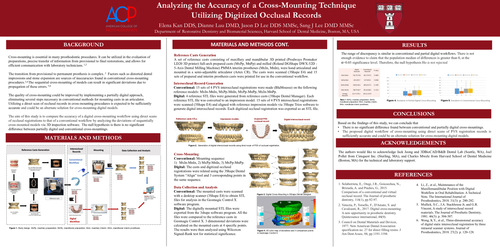
The range of discrepancy appears to be similar in conventional and partial digital workflows. It is concluded that the null hypothesis Ho is not rejected. Therefore, there is not enough evidence to claim that the population median of differences is greater than 0, at the alpha =0.05 significance level.
Conclusions:
Based on the findings of this study, we can conclude that
• There is no significant difference expected between conventional and partially digital cross-mountings.
• The proposed digital workflow of cross-mounting using direct scans of PVS registration records is sufficiently accurate and could be an alternate solution for cross-mounting digital models.
References:
- Solaberrieta, E., Otegi, J.R., Goicoechea, N., Brizuela, A. and Pradies, G., 2015. Comparison of a conventional and virtual occlusal record. The Journal of prosthetic dentistry, 114(1), pp.92-97.
- Venezia, P., Torsello, F., D'Amato, S. and Cavalcanti, R., 2017. Digital cross-mounting: A new opportunity in prosthetic dentistry. Quintessence international, 48(9).
- Council on Dental Materials and Devices, 1977. New American Dental Association specification no. 27 for direct filling resins. J Am Dent Assoc, 94, pp.1191-1194.
- Wong, K.Y., et al., Three‐dimensional accuracy of digital static interocclusal registration by three intraoral scanner systems. Journal of Prosthodontics, 2018. 27(2): p. 120-128.
- Li, Z., et al., Maintenance of the Maxillomandibular Position with Digital Workflow in Oral Rehabilitation: A Technical Note. The International Journal of Prosthodontics, 2018. 31(3): p. 280-282.
- Mullick, S.C., J.A. Stackhouse Jr, and G.R. Vincent, A study of interocclusal record materials. The Journal of Prosthetic Dentistry, 1981. 46(3): p. 304-307.