105 posters, 2 topics, 24 sessions, 264 authors, 71 institutions
ePostersLive by SciGen Technologies S.A. All rights reserved.
2022 ACP Annual Session
2 - 5 November | Austin, TX

65
Oral Rehabilitation after Fibula Free Flap Reconstruction of Mandible: Literature Review
Part of Topic
Original Research
Oral Rehabilitation after Fibula Free Flap Reconstruction of Mandible: Literature Review
Ivana Petrovic DDS, Thomas Giugliano DDS, Mijin Choi DDS, MS, MBA, FACP
Introduction
Complete oral/dental restoration after segmental mandibulectomy for oral cancer has been a long-standing problem. The Fibula Free Flap (FFF) has significantly improved restoration of esthetic form and facial contour. In addition placement of dental implants in the FFF has allowed clinicians to provide more stable prostheses with improved oral rehabilitation. The purpose of this presentation is to summarize a literature review on the current status of the outcomes after dental implants in FFF.
Objectives
This literature review aims to summarize the reported results from published literature in the English language from 2005-2021 on dental implants in FFF and their success rate and impact on oral rehabilitation.
Methods
A PubMed search was conducted using the keywords: “fibula free flap” AND “mandible reconstruction” AND “dental implants” AND “outcomes”, between 2005 and 2021. The abstracts of retrieved articles were reviewed to screen for the intended information. The inclusion criteria required information on dental implant survival, complications and functional outcomes. Selected articles were reviewed in detail to report frequency of immediate or secondary implants, complications, impact of radiotherapy, implant success rate and dentist assessed functional outcomes and patient satisfaction.
Results
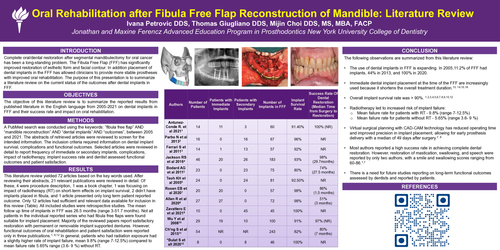
This literature review yielded 72 articles based on the key words used. After reviewing their abstracts, 21 relevant publications were reviewed in detail. Of these, 4 were procedure description, 1 was a book chapter, 1 was focusing on impact of radiotherapy (RT) on short-term effects on implant survival, 2 didn’t have implants placed in fibula, and 1 article presented only long term patient reported outcome. Only 12 articles had sufficient and relevant data available for inclusion in this review (Table). All included studies were retrospective studies. The mean follow up time of implants in FFF was 26.5 months (range 3-51.7 months). Not all patients in the individual reported series who had fibula free flaps were found suitable for implant placement. Majority of the reviewed papers report satisfactory restoration with permanent or removable implant supported dentures. However, functional outcomes of oral rehabilitation and patient satisfaction were reported only in three publications.1, 8,12 In general, patients who had radiation exposure had a slightly higher rate of implant failure, mean 9.8% (range 7-12.5%) compared to mean failure rate 5.65% range (3.6- 9 %) without RT.
Conclusion
The following observations are summarized from this literature review:
- The use of dental implants in FFF is expanding. In 2005,11.2% of FFF had implants, 44% in 2013, and 100% in 2020.
- Immediate dental implant placement at the time of the FFF are increasingly used because it shortens the overall treatment duration.13, 14,15,16
- Overall implant survival rate was > 90%. 1,2,3,4,5,6,7,8,9,10,12
- Radiotherapy led to increased risk of implant failure:
- Mean failure rate for patients with RT - 9.8% (range 7-12.5%)
- Mean failure rate for patients without RT - 5.65% (range 3.6- 9 %)
- Virtual surgical planning with CAD-CAM technology has reduced operating time and improved precision in implant placement, allowing for early prosthesis delivery with a median of 49 days after surgery.7, 8
- Most authors reported a high success rate in achieving complete dental restoration. However, restoration of mastication, swallowing, and speech were reported by only two authors, with a smile and swallowing scores ranging from 60-86.1,7
- There is a need for future studies reporting on long-term functional outcomes assessed by dentists and reported by patients.