105 posters, 2 topics, 24 sessions, 264 authors, 71 institutions
ePostersLive by SciGen Technologies S.A. All rights reserved.
2022 ACP Annual Session
2 - 5 November | Austin, TX

52
Microleakage and Bacterial Adhesion with Three Restorative Materials Used to Seal Screw-access Channels of Implant Abutments: An In vitro Study
Poster Presenter
Authors
Affiliations
Part of Topic
Original Research
Microleakage and Bacterial Adhesion with Three Restorative Materials Used to Seal Screw-access Channels of Implant Abutments: An In vitro Study
Zainab AlBasry: B.D.S., Graduate Prosthodontics, Marquette University, WI, USA. Firas AlQarawi: , DScD, CAGS, Imam Abdulrahman bin Faisal University, Saudi Arabia.
Introduction: Proper sealing of the access channel of screw- retained prosthesis is advisable for the long-term success of the implant system(1). Improper Sealing can lead to microbial microleakage and colonization of the internal implant system, leading to increased risk of implant failure(2,3).
Aim: This study aimed to compare the bacterial adhesion and microleakage with three restorative materials used to cover the access channels of screw-retained implant prostheses.
Materials and Methods: Eighteen titanium straight abutments (Hex-lock® Zimmer) were torqued into implant analogs, which were then subdivided into three groups. The samples of each group were filled with PTFE tape and sealed with the following restorative materials (Group A: composite resin; Group B: acrylic resin; and Group C: bis-acryl).
Thermocycling test: All groups were thermocycled for 2 weeks following a standardized protocol: 2000 cycles at 5 C and 55 C.
Micobiology: Samples were emerged in a container filled with contaminant solution of E-coli and incubated for 7 days. Surface swabs were obtained and samples from access channels were collected then incubated for 24hs and 7 days respectively. The results were statistically analyzed using Kruskal-Wallis and Chi-square tests.
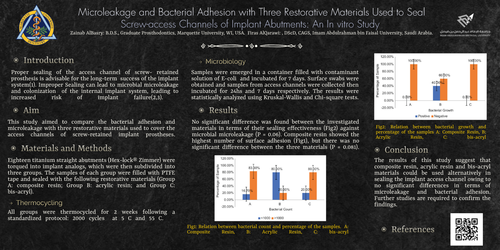
Results: No significant difference was found between the investigated materials in terms of their sealing effectiveness (Fig2) against microbial microleakage (P = 0.06). Composite resin showed the highest number of surface adhesion (Fig1), but there was no significant difference between the three materials (P = 0.081).
Conclusion: The results of this study suggest that composite resin, acrylic resin and bis-acryl materials could be used alternatively in sealing the implant access channel owing to no significant differences in terms of microleakage and bacterial adhesion. Further studies are required to confirm the findings.