105 posters, 2 topics, 24 sessions, 264 authors, 71 institutions
ePostersLive by SciGen Technologies S.A. All rights reserved.
2022 ACP Annual Session
2 - 5 November | Austin, TX

42
Comparison of Surface Characteristics of Denture Base Resin Materials with Two Different Surface Treatment Protocols
Poster Presenter
Part of Topic
Original Research
Comparison of Surface Characteristics of Denture Base Resin Materials with Two Different Surface Treatment Protocols
Introduction: A digital complete denture when compared to the prosthesis manufactured conventionally, the digital complete denture has superior dimensional stability, higher retention, higher hardness, better wear resistance, lower surface loss, lower surface roughness, and more accurate tissue adaptation. With the digital archive of design files, a new digital denture can be manufactured with significantly reduced clinical chair time and visits. (1,3,4,5,8,11,12,13)
Aim of the Study: Investigate the effects of four denture manufacturing techniques and materials with two surface treatment protocols on surface hardness, wear resistance, surface roughness, and gloss of denture resin base materials.
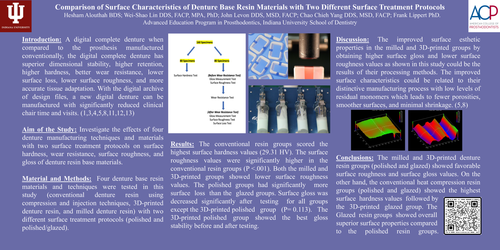
Material and Methods: Four denture base resin materials and techniques were tested in this study (conventional denture resin using compression and injection techniques, 3D-printed denture resin, and milled denture resin) with two different surface treatment protocols (polished and polished/glazed).
Results: The conventional resin groups scored the highest surface hardness values (29.31 HV). The surface roughness values were significantly higher in the conventional resin groups (P <.001). Both the milled and 3D-printed groups showed lower surface roughness values. The polished groups had significantly more surface loss than the glazed groups. Surface gloss was decreased significantly after testing for all groups except the 3D printed polished group (P= 0.113). The 3D printed polished group showed the best gloss stability before and after testing.
Discussion: The improved surface esthetic properties in the milled and 3D printed groups by obtaining higher surface gloss and lower surface roughness values as shown in this study could be the results of their processing methods. The improved surface characteristics could be related to their distinctive manufacturing process with low levels of residual monomers which leads to fewer porosities, smoother surfaces, and minimal shrinkage. (5,8)
Conclusions: The milled and 3D-printed denture resin groups (polished and glazed) showed favorable surface roughness and surface gloss values. On the other hand, the conventional heat compression resin groups (polished and glazed) showed the highest surface hardness values followed by the 3D-printed glazed group. The Glazed resin groups showed overall superior surface properties compared to the polished resin groups.