105 posters, 2 topics, 24 sessions, 264 authors, 71 institutions
ePostersLive by SciGen Technologies S.A. All rights reserved.
2022 ACP Annual Session
2 - 5 November | Austin, TX
37
Digital Denture Workflow at Boston University Pre-Doc Dental Education
Poster Presenter
Authors
Affiliations
DUMMY, Boston University Henry Goldman School of Dental Medicine
Part of Topic
Highlights
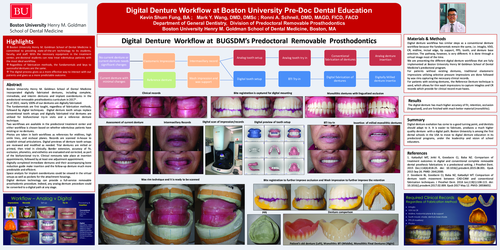
Boston University Henry M. Goldman School of Dental Medicine incorporated digitally fabricated dentures, including complete, immediate, and interim dentures and implant overdentures in the predoctoral removable prosthodontics curriculum in 20171 .
As of 2022, nearly 100% of our dentures are digitally fabricated.
The fundamentals are first taught, regardless of fabrication methods, followed by digital techniques. Digital denture tooth setups replace conventional tooth setups and digitally fabricated trial dentures are utilized for biofunctional try-in visits and a reference denture technique.
Two workflows are available in the predoctoral treatment center and either workflow is chosen based on whether edentulous patients have existing or no dentures.
Photos are taken in both workflows as references for midlines, high smile lines, and occlusal planes. Records are scanned in-house to establish virtual articulations. Digital previews of denture tooth setups are reviewed and modified as needed. Trial dentures are milled or printed, then tried in clinically. Border extension, accuracy of fit, occlusion, phonetics, and esthetics are evaluated and corrected, as part of the biofunctional try-in. Clinical remounts take place at insertion appointments, followed by at least one adjustment appointment.
Digitally completed immediate dentures and their accompanying bone reduction guide make insertion and the follow-up denture much more predictable and efficient.
Space analysis for implant overdentures could be viewed in the virtual setups as well as pockets for the attachment housings.
Digital denture technology can provide a full-service removable prosthodontic procedure. Indeed, any analog denture procedure could be converted to a digital path at any stage.
Materials & Methods
Digital denture workflow has similar steps as a conventional denture workflow because the fundamentals remain the same, i.e. intaglio, VDO, CR, midline, incisal edge, lip support, PPS, tooth, and denture base selection. The pathway, however, is very different. It is done through a virtual image most of the time.
We are presenting the different digital denture workflows that are fully implemented at Boston University Henry M Goldman School of Dental Medicine’s predoctoral program.
For patients without existing dentures, traditional elastomeric impressions utilizing selective pressure impressions are done followed by wax rims capturing the necessary clinical records.
For patients with existing dentures, the Reference Denture technique is used, which allows for thin wash impressions to capture intaglios and CR records which provide for clinical record must-haves.
Results
The digital denture has much higher accuracy of fit, retention, occlusion (lingualized), and are finished with much better material (monolithic).
Summary
Digital denture evolution has come to a good turning point, and dentists should adapt to it. It is easier to fabricate, produces a much higher quality denture with a digital path. Boston University is among the first dental schools in the USA to move to digital denture education in its predoctoral programs, under the leadership and vision of school educators.
References
1. Kattadiyil MT, Jekki R, Goodacre CJ, Baba NZ. Comparison of treatment outcomes in digital and conventional complete removable dental prosthesis fabrications in a predoctoral setting. J Prosthet Dent. 2015 Dec;114(6):818-25. doi: 10.1016/j.prosdent.2015.08.001. Epub 2015 Sep 26. PMID: 26412000.
2. Goodacre BJ, Goodacre CJ, Baba NZ, Kattadiyil MT. Comparison of denture tooth movement between CAD-CAM and conventional fabrication techniques. J Prosthet Dent. 2018 Jan;119(1):108-115. doi: 10.1016/j.prosdent.2017.02.009. Epub 2017 May 12. PMID: 28506652.