105 posters, 2 topics, 24 sessions, 264 authors, 71 institutions
ePostersLive by SciGen Technologies S.A. All rights reserved.
2022 ACP Annual Session
2 - 5 November | Austin, TX

34
The Role of Inhalant Cannabidiol (CBD) in the Treatment of Malignant Melanoma in a Murine Model
Poster Presenter
Authors
Affiliations
Part of Topic
Original Research
The Role of Inhalant Cannabidiol (CBD) in the Treatment of Malignant Melanoma in a Murine Model
Jennine E. Jarrett, DDS, MS
The Dental College of Georgia, Augusta University
Introduction
Skin cancer is the most common type of cancer worldwide, and many skin cancers are found in the Head & Neck region1,3. Dentists are in an advantageous position to be among the first to identify these conditions. Many clinicians recommend a complementary approach to treating skin cancer, in which adjunct therapies are used in conjunction with conventional medical treatment2. Recently, studies have begun to examine the effects of cannabidiol in slowing the growth of cancer cells3. The objective of this research is to determine if cannabidiol results in alterations of the tumor size by modifying the inflammatory mediators found in malignant melanoma.
Hypothesis
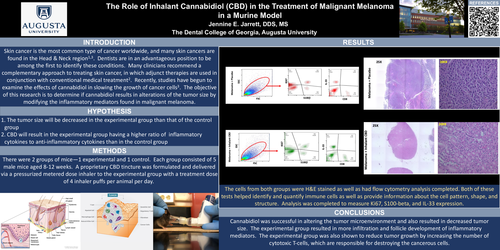
There were 2 groups of mice—1 experimental and 1 control. Each group consisted of 5 male mice aged 8-12 weeks. A proprietary CBD tincture was formulated and delivered via a pressurized metered dose inhaler to the experimental group with a treatment dose of 4 inhaler puffs per animal per day.
Results
The cells from both groups were H&E stained as well as had flow cytometry analysis completed. Both of these tests helped identify and quantify immune cells as well as provide information about the cell pattern, shape, and structure. Analysis was completed to measure Ki67, S100-beta, and IL-33 expression.
Conclusions
Cannabidiol was successful in altering the tumor microenvironment and also resulted in decreased tumor size. The experimental group resulted in more infiltration and follicle development of inflammatory mediators. The experimental group was also shown to reduce tumor growth by increasing the number of cytotoxic T-cells, which are responsible for destroying the cancerous cells.