105 posters, 2 topics, 24 sessions, 264 authors, 71 institutions
ePostersLive by SciGen Technologies S.A. All rights reserved.
2022 ACP Annual Session
2 - 5 November | Austin, TX

30
Management of complications in 3D mispositioned implants – Case series
Poster Presenter
Authors
Affiliations
Part of Topic
Management of Complications in 3D Malpositioned Implants – Case Series
Eden Skopp, Loana Tovar Suinaga DDS, MS, FACP
University of Maryland, School of Dentistry
Abstract
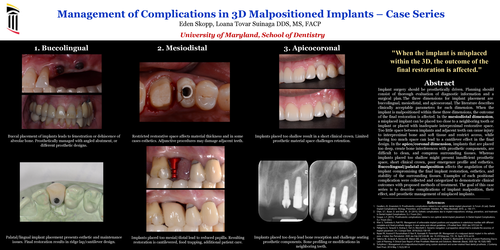
Implant surgery should be prosthetically driven. Planning should consist of thorough evaluation of diagnostic information and a surgical plan. The three dimensions for implant placement are buccolingual, mesiodistal, and apicocoronal. The literature describes clinically acceptable parameters for each dimension. When the implant is malpositioned within these three dimensions, the outcome of the final restoration is affected. In the mesiodistal dimension, a misplaced implant can be placed too close to a neighboring tooth or implant or placed with inadequate interproximal restorative space. Too little space between implants and adjacent teeth can cause injury to interproximal bone and soft tissue and restrict access, while having too much space can lead to a cantilever effect in the final design. In the apico/coronal dimension, implants that are placed too deep, create bone interferences with prosthetic components, are difficult to clean, and compress surrounding tissues. Whereas implants placed too shallow might present insufficient prosthetic space, short clinical crown, poor emergence profile and esthetics. Buccolingual/palatal malposition affects the angulation of the implant compromising the final implant restoration, esthetics, and stability of the surrounding tissues. Examples of each positional complication were collected and categorized to demonstrate clinical outcomes with proposed methods of treatment. The goal of this case series is to describe complications of implant malposition, their effect, and prosthetic management of misplaced implants.
1. Buccolingual
Buccal placement of implants leads to fenestration or dehiscence of alveolar bone. Prosthetically managed with angled abutment, or different prosthetic designs.
Palatal/lingual implant placement presents esthetic and maintenance issues. Final restoration results in ridge lap/cantilever design.
2. Mesiodistal
Restricted restorative space affects material thickness and in some cases esthetics. Adjunctive procedures may damage adjacent teeth.
Implants placed too mesial/distal lead to reduced papilla. Resulting restoration is cantilevered, food trapping, additional patient care.
3. Apicocoronal
Implants placed too shallow result in a short clinical crown. Limited prosthetic material space challenges retention.
Implants placed too deep lead bone resorption and challenge seating prosthetic components. Bone profiling or modifications in neighboring teeth.
References