105 posters, 2 topics, 24 sessions, 264 authors, 71 institutions
ePostersLive by SciGen Technologies S.A. All rights reserved.
2022 ACP Annual Session
2 - 5 November | Austin, TX

148
Fabricating a definitive obturator using a CAD-CAM assisted workflow
Poster Presenter
Part of Topic
Fabricating a definitive obturator using a CAD-CAM assisted workflow
Paul Kutaa, Leela Breitman, DMDb, Wendy Clark, DDS, MSc, David Felton, DDS, MS, FACPd, Rafiullah Bashiri, DDS, MDS, AFAAMPe
Student Doctora, Residentb, Professorc, Prosthodontics Program Directord, Maxillofacial Course Directore
Division of Prosthodontics, Department of Comprehensive Oral Health, University of North Carolina Adams School of Dentistry
Introduction: Conventional obturator fabrication involves multiple appointments and is time- and labor-intensive for both the patient and practitioner. For patients with pre-existing obturator prostheses, computer-aided design and manufacturing (CAD-CAM) offers the potential to shorten production time for replacement prostheses. This case presentation describes how a definitive obturator, replacing an ill-fitting prosthesis, was digitally designed and fabricated.
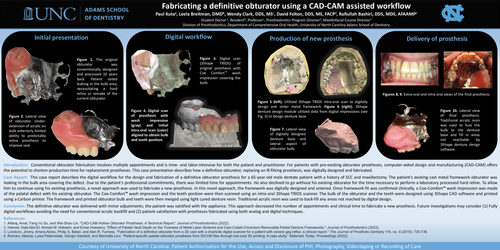
Case Report: This case report describes the digital workflow for the design and fabrication of a definitive obturator prosthesis for a 65-year-oldmale dentate patient with a history of SCC and maxillectomy. The patient's existing cast metal framework obturator was leaking in the bulb area covering the defect. Due to the patient’s professional commitments, there was limited time for appointments. He also declined to go without his existing obturator for the time necessary to perform a laboratory processed hard reline. To allow him to continue using his existing prosthesis, a novel approach was used to fabricate a new prosthesis. In this novel approach, the framework was digitally designed and sintered. Once framework fit was confirmed clinically, a Coe-Comfort™ wash impression was made of the palatal defect with his existing obturator. The Coe-Comfort™ wash impression and the teeth position were then scanned using an intra-oral 3Shape TRIOS scanner. The bulb of the obturator and the teeth were designed using 3Shape CAD software and printed using a Carbon printer. The framework and printed obturator bulb and teeth were then merged using light cured denture resin. Traditional acrylic resin was used to back-fill any areas not reached by digital design.
Conclusion: The definitive obturator was delivered with minor adjustments; the patient was satisfied with the appliance. This approach decreased the number of appointments and clinical time to fabricate a new prosthesis. Future investigations may consider (1) Fully digital workflows avoiding the need for conventional acrylic backfill and (2) patient satisfaction with prostheses fabricated using both analog and digital techniques.