105 posters, 2 topics, 24 sessions, 264 authors, 71 institutions
ePostersLive by SciGen Technologies S.A. All rights reserved.
2022 ACP Annual Session
2 - 5 November | Austin, TX

115
<em>Flexural Strength, Flexural Modulus and Fatigue Limit of</em> <em>3D-printed resins for denture teeth and temporary crown and bridge</em>
Poster Presenter
Part of Topic
Original Research
Flexural Strength, Flexural Modulus and Fatigue Limit of 3D-printed resins for denture teeth and temporary crown and bridge
Authors: Neimar Sartori1, Jefferson Matos3,2, Panagiotis Zoidis1, Sherif Hosney1, Jean-Francois Roulet2, Dayane Oliveira2, Mateus G. Rocha2
1 Division of Prosthodontics, Department of Restorative Dental Sciences, University of Florida College of Dentistry, Gainesville, FL
2 Center for Dental Biomaterials, Department of Restorative Dental Sciences, College of Dentistry, University of Florida, Gainesville, FL.
3 Department of Dental Materials and Prosthodontics, São Paulo State University (UNESP), Institute of Science and Technology, São José dos Campos, Sao Paulo, Brazil.
Objectives: To evaluate the flexural strength (FS), flexural modulus (FM), and fatigue limit (FL) of 3D-printed denture teeth (DT) and temporary crown and bridge (T-C&B) resins.
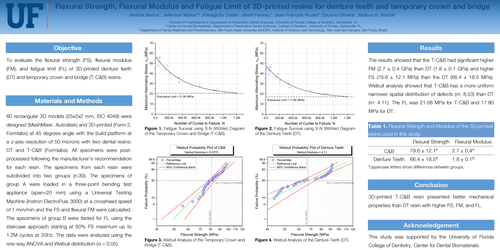
Materials and Methods: 60 rectangular 3D models (25x2x2 mm, ISO 4049) were designed (MeshMixer, Autodesk) and 3D-printed (Form 2, Formlabs) at 45 degrees angle with the build platform at a z-axis resolution of 50 microns with two dental resins: DT and T-C&B (Formlabs). All specimens were post-processed following the manufacturer's recommendation for each resin. The specimens from each resin were subdivided into two groups (n:30). The specimens of group A were loaded in a three-point bending test appliance (span=20 mm) using a Universal Testing Machine (Instron ElectroPuls 3000) at a crosshead speed of 1 mm/min and the FS and flexural FM were calculated. The specimens of group B were tested for FL using the staircase approach starting at 60% FS maximum up to 1.2M cycles at 20Hz. The data were analyzed using the one-way ANOVA and Weibull distribution (α = 0.05).
Results: The results showed that the T-C&B had significant higher FM (2.7 ± 0.4 GPa) than DT (1.8 ± 0.1 GPa) and higher FS (79.6 ± 12.1 MPa) than the DT (66.4 ± 18.5 MPa). Weibull analysis showed that T-C&B has a more uniform narrower spatial distribution of defects (m: 8.53) than DT (m: 4.11). The FL was 21.08 MPa for T-C&B and 17.80 MPa for DT.
Conclusion: 3D-printed T-C&B resin presented better mechanical properties than DT resin with higher FS, FM, and FL.
Keywords: 3D-printed, Dental Materials, Prosthodontics.
Conflict of interest: NONE.