105 posters, 2 topics, 24 sessions, 264 authors, 71 institutions
ePostersLive by SciGen Technologies S.A. All rights reserved.
2022 ACP Annual Session
2 - 5 November | Austin, TX

113
Comparison of the effect of different surface treatments on the bond strength of different cementswith nickel-chromium metal alloy: An in vitro study
Poster Presenter
Authors
Affiliations
Part of Topic
Original Research
Comparison of the Effect of Different Surface Treatments on the Bond Strength of Different Cements with Nickel Chromium Metal Alloy: An In-Vitro Study
Saumya Kapoor BDS, Fei Liu DDS PhD, Berna Saglik DDS MS, Nayana Prabhu MDS University of Michigan School of Dentistry
•Choice of correct luting cement and surface condition of the intaglio surface of the fixed prosthesis important.Adhesion of the cements to the intaglio surface of indirect restorations is imperative to durability of the restoration
•Numerous superficial conditioning methods are present which alter the alloys surface and modify their morphological characteristics (ex:sandblasting, chemical substances such as acid, electrolytic deposition of ions chemically more reactive) promoting a greater affinity between the alloys and the cements, thereby increasing the retention and longevity of the fixed prosthesis.
•High solubility associated with conventional cements has shifted the focus to resin based luting agents. Self-adhesive resin cements offer high fracture strength, adequate bond to the dental structure and low solubility when exposed to oral fluids
•Bonding between resins and metals is a physicochemical phenomenon, resulting in mechanical interlocking of the cement with the metal surface and chemical interactions between the oxides present on the surface of metals and the carboxylic or phosphoric acid derivatives present in the cements.
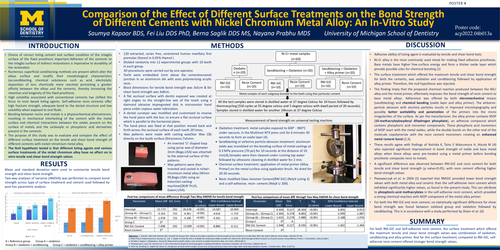
•The purpose of this study was to evaluate and compare the effect of different surface treatment on the tensile and shear bond strength of different cements with nickel–chromium metal alloy.
•The Null hypothesis tested is that different luting agents and various surface treatments of the nickel chromium alloy have no effect on in vitro tensile and shear bond strength values.