206 posters, 13 topics, 5 sessions, 713 authors, 293 institutions
ePostersLive by SciGen Technologies S.A. All rights reserved.
AAPS 104th Annual Meeting
May 2-5, 2026 | Lihue, HI

D12
Mental Health Outcomes Following Mastectomy With And Without Breast Reconstruction: A Propensity-matched Analysis
Poster Presenter
Part of Topic
Breast Reconstruction
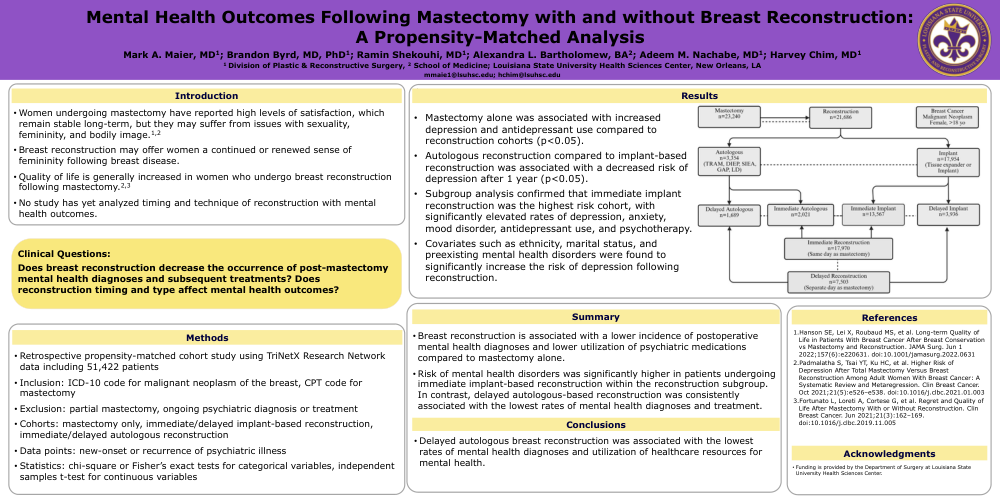
Mental Health Outcomes Following Mastectomy with and without Breast Reconstruction: A Propensity-Matched Analysis Mark A. Maier, MD1; Brandon Byrd, MD, PhD1; Ramin Shekouhi, MD1; Alexandra L. Bartholomew, BA2; Adeem M. Nachabe, MD1; Harvey Chim, MD1 1 Division of Plastic & Reconstructive Surgery, 2 School of Medicine; Louisiana State University Health Sciences Center, New Orleans, LA mmaie1@lsuhsc.edu; hchim@lsuhsc.edu Introduction sads Results • Women undergoing mastectomy have reported high levels of satisfaction, which remain stable long-term, but they may suffer from issues with sexuality, femininity, and bodily image.1,2 • Breast reconstruction may offer women a continued or renewed sense of femininity following breast disease. • Quality of life is generally increased in women who undergo breast reconstruction following mastectomy.2,3 • No study has yet analyzed timing and technique of reconstruction with mental health outcomes. Clinical Questions: Does breast reconstruction decrease the occurrence of post-mastectomy mental health diagnoses and subsequent treatments? Does reconstruction timing and type affect mental health outcomes? Methods • Retrospective propensity-matched cohort study using TriNetX Research Network data including 51,422 patients • Inclusion: ICD-10 code for malignant neoplasm of the breast, CPT code for mastectomy • Exclusion: partial mastectomy, ongoing psychiatric diagnosis or treatment • Cohorts: mastectomy only, immediate/delayed implant-based reconstruction, immediate/delayed autologous reconstruction • Data points: new-onset or recurrence of psychiatric illness • Statistics: chi-square or Fisher’s exact tests for categorical variables, independent samples t-test for continuous variables • Mastectomy alone was associated with increased depression and antidepressant use compared to reconstruction cohorts (p<0.05). • Autologous reconstruction compared to implant-based reconstruction was associated with a decreased risk of depression after 1 year (p<0.05). • Subgroup analysis confirmed that immediate implant reconstruction was the highest risk cohort, with significantly elevated rates of depression, anxiety, mood disorder, antidepressant use, and psychotherapy. • Covariates such as ethnicity, marital status, and preexisting mental health disorders were found to significantly increase the risk of depression following reconstruction. Summary • Breast reconstruction is associated with a lower incidence of postoperative mental health diagnoses and lower utilization of psychiatric medications compared to mastectomy alone. • Risk of mental health disorders was significantly higher in patients undergoing immediate implant-based reconstruction within the reconstruction subgroup. In contrast, delayed autologous-based reconstruction was consistently associated with the lowest rates of mental health diagnoses and treatment. Conclusions • Delayed autologous breast reconstruction was associated with the lowest rates of mental health diagnoses and utilization of healthcare resources for mental health. References 1.Hanson SE, Lei X, Roubaud MS, et al. Long-term Quality of Life in Patients With Breast Cancer After Breast Conservation vs Mastectomy and Reconstruction. JAMA Surg. Jun 1 2022;157(6):e220631. doi:10.1001/jamasurg.2022.0631 2.Padmalatha S, Tsai YT, Ku HC, et al. Higher Risk of Depression After Total Mastectomy Versus Breast Reconstruction Among Adult Women With Breast Cancer: A Systematic Review and Metaregression. Clin Breast Cancer. Oct 2021;21(5):e526–e538. doi:10.1016/j.clbc.2021.01.003 3.Fortunato L, Loreti A, Cortese G, et al. Regret and Quality of Life After Mastectomy With or Without Reconstruction. Clin Breast Cancer. Jun 2021;21(3):162–169. doi:10.1016/j.clbc.2019.11.005