206 posters, 13 topics, 5 sessions, 713 authors, 293 institutions
ePostersLive by SciGen Technologies S.A. All rights reserved.
AAPS 104th Annual Meeting
May 2-5, 2026 | Lihue, HI

D109
Evaluation Of Outcomes In Breast Reconstruction Patients Following Textured Implant Exposure: A 25-year Institutional Review
Poster Presenter
Authors
Victoria Tucci, Darby Little, Adrian McArdle, Laura Snell, Joan Lipa
Affiliations
Temerty Faculty of Medicine, University of Toronto, Temerty Faculty of Medicine, University of Toronto, Toronto, ON, Canada, Division of Plastic, Reconstructive & Aesthetic Surgery, Department of Surgery, University of Toronto, Toronto, ON, Canada, Division of Plastic Surgery, Trillium Health Partners, Mississauga, ON, Canada, Division of Plastic and Reconstructive Surgery, Department of Surgery, Sunnybrook Health Sciences Centre, Toronto, ON, Canada
Part of Topic
Breast Reconstruction
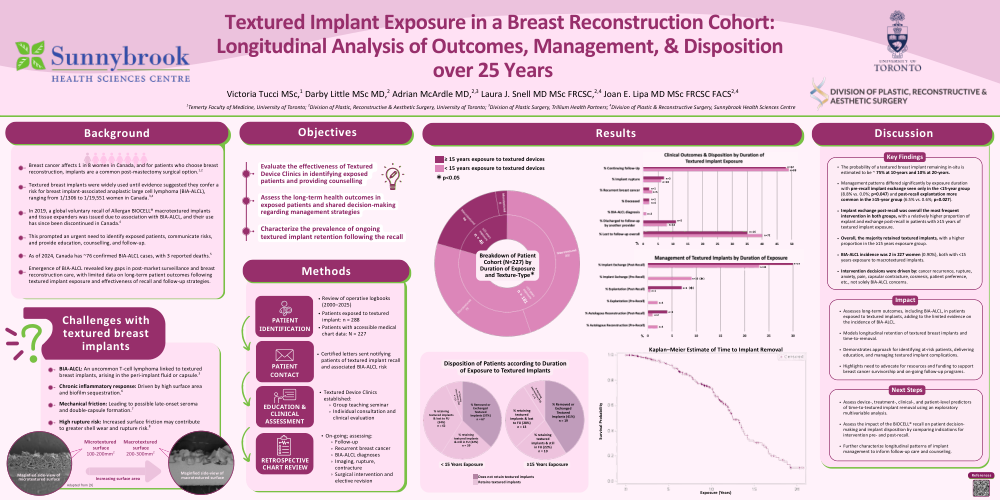
Textured Implant Exposure in a Breast Reconstruction Cohort: Longitudinal Analysis of Outcomes, Management, & Disposition over 25 Years
Victoria Tucci MSc, Darby Little MSc MD, Adrian McArdle MD, Laura J. Snell MD MSc FRCSC, Joan E. Lipa MD MSc FRCSC FACS
Background
Breast cancer affects 1 in 8 women in Canada, and for patients who choose breast reconstruction, implants are a common post-mastectomy surgical option. Textured breast implants were widely used until evidence suggested they confer a risk for breast implant-associated anaplastic large cell lymphoma (BIA-ALCL), ranging from 1/1306 to 1/19,551 women in Canada. In 2019, a global voluntary recall of Allergan BIOCELL® macrotextured implants and tissue expanders was issued due to association with BIA-ALCL, and their use has since been discontinued in Canada. This prompted an urgent need to identify exposed patients, communicate risks, and provide education, counselling, and follow-up. As of 2024, Canada has ~76 confirmed BIA-ALCL cases, with 3 reported deaths. 5 Emergence of BIA-ALCL revealed key gaps in post-market surveillance and breast reconstruction care, with limited data on long-term patient outcomes following textured implant exposure and effectiveness of recall and follow-up strategies.
Challenges with textured breast implants
Mechanical friction: Leading to possible late-onset seroma and double-capsule formation.
Chronic inflammatory response: Driven by high surface area and biofilm sequestration.
BIA-ALCL: An uncommon T-cell lymphoma linked to textured breast implants, arising in the peri-implant fluid or capsule.
High rupture risk: Increased surface friction may contribute to greater shell wear and rupture risk.
Objectives
Evaluate the effectiveness of Textured Device Clinics in identifying exposed patients and providing counselling.
Assess the long-term health outcomes in exposed patients and shared decision-making regarding management strategies.
Characterize the prevalence of ongoing textured implant retention following the recall.
Methods
Review of operative logbooks (2000–2025)
Patients exposed to textured implant: n = 288
Patients with accessible medical chart data: N = 227
Certified letters sent notifying patients of textured implant recall and associated BIA-ALCL risk
Textured Device Clinics established: Group teaching seminar Individual consultation and clinical evaluation
On-going; assessing: Follow-up, Recurrent breast cancer, BIA-ALCL diagnoses, Imaging, rupture, contracture, Surgical intervention, and elective revision
Discussion
Key Findings
The probability of a textured breast implant remaining in-situ is estimated to be ~ 75% at 10-years and 10% at 20-years. Management patterns differed significantly by exposure duration with pre-recall implant exchange seen only in the <15-year group (8.8% vs. 0.0%; p=0.047) and post-recall explantation more common in the ≥15-year group (6.5% vs. 0.6%; p=0.027). Implant exchange post-recall was overall the most frequent intervention in both groups, with a relatively higher proportion of explant and exchange post-recall in patients with ≥15 years of textured implant exposure. Overall, the majority retained textured implants, with a higher proportion in the ≥15 years exposure group. BIA-ALCL incidence was 2 in 227 women (0.90%), both with <15 years exposure to macrotextured implants. Intervention decisions were driven by: cancer recurrence, rupture, anxiety, pain, capsular contracture, cosmesis, patient preference, etc., not solely BIA-ALCL concerns.
Impact
Assesses long-term outcomes, including BIA-ALCL, in patients exposed to textured implants, adding to the limited evidence on the incidence of BIA-ALCL. Models longitudinal retention of textured breast implants and time-to-removal. Demonstrates approach for identifying at-risk patients, delivering education, and managing textured implant complications. Highlights need to advocate for resources and funding to support breast cancer survivorship and on-going follow-up programs.
Next Steps
Assess device-, treatment-, clinical-, and patient-level predictors of time-to-textured implant removal using an exploratory multivariable analysis. Assess the impact of the BIOCELL® recall on patient decisionmaking and implant disposition by comparing indications for intervention pre- and post-recall. Further characterize longitudinal patterns of implant management to inform follow-up care and counseling.