206 posters, 13 topics, 5 sessions, 713 authors, 293 institutions
ePostersLive by SciGen Technologies S.A. All rights reserved.
AAPS 104th Annual Meeting
May 2-5, 2026 | Lihue, HI

D104
Outcomes Of Omental Fat-augmented Free Flap Breast Reconstruction Across Bmi Categories
Poster Presenter
Authors
Elizabeth Tadevosyan, Subin Cho, Kassandra Carrion, Nitya Devisetti, Megan Vu, Elizabeth Cox, Mimi Wu Young, Dung Nguyen
Affiliations
Stanford University, Stanford University School of Medicine, Department of Plastic and Reconstructive Surgery, MedStar Georgetown University Hospital, Division of Plastic & Reconstructive Surgery, Stanford University, Rutgers School of Medicine, California University of Science and Medicine
Part of Topic
Breast Reconstruction
Objective:
- BMI is a key determinant in autologous breast reconstruction.
- Low BMI: limited donor tissue, yet higher satisfaction with autologous vs. implant-based reconstruction.
- High BMI: adequate tissue but increased donor-site morbidity and wound complications.
- The omental fat-augmented free flap (O-FAFF) utilizes laparoscopic harvest and may broaden autologous reconstruction options across BMI groups.
- Objective: Compare outcomes across low (<18.5), normal (18.5–24.9), and high (≥25) BMI patients.
Methods:
- Design: Retrospective review of consecutive O-FAFF breast reconstructions by a single surgeon.
- Outcomes: Major and minor complications, abdominal donor-site morbidity, and revision procedures.
- Analysis: Fisher’s exact test for unadjusted comparisons.
- Adjusted analysis: Logistic regression controlling for preoperative radiotherapy.
Results/Conclusion:
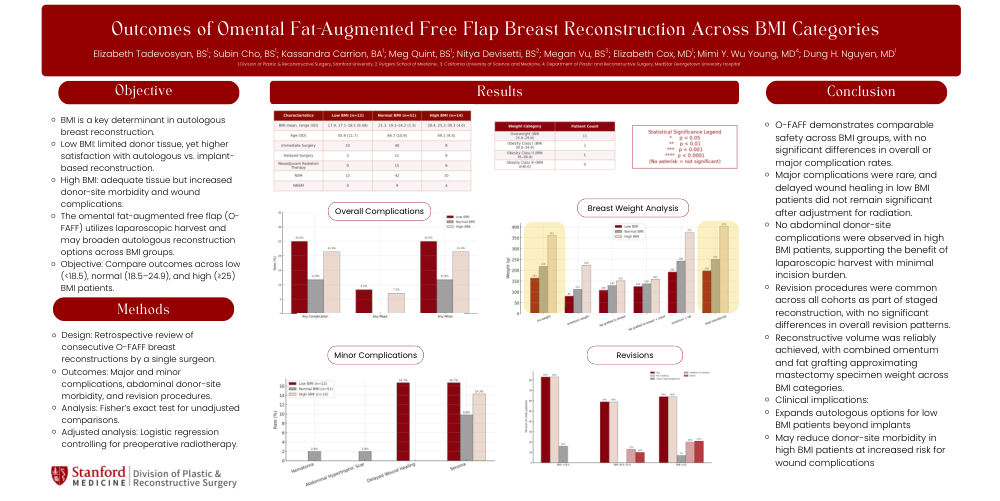
- O-FAFF demonstrates comparable safety across BMI groups, with no significant differences in overall or major complication rates.
- Major complications were rare, and delayed wound healing in low BMI patients did not remain significant after adjustment for radiation.
- No abdominal donor-site complications were observed in high BMI patients, supporting the benefit of laparoscopic harvest with minimal incision burden.
- Revision procedures were common across all cohorts as part of staged reconstruction, with no significant differences in overall revision patterns.
- Reconstructive volume was reliably achieved, with combined omentum and fat grafting approximating mastectomy specimen weight across BMI categories.
- Clinical implications:
- Expands autologous options for low BMI patients beyond implants
- May reduce donor-site morbidity in high BMI patients at increased risk for wound complications