206 posters, 13 topics, 5 sessions, 713 authors, 293 institutions
ePostersLive by SciGen Technologies S.A. All rights reserved.
AAPS 104th Annual Meeting
May 2-5, 2026 | Lihue, HI

PC52
The Mental Health Benefits Of Limb Salvage With Free Tissue Transfer In Lower Extremity Trauma
Poster Presenter
Authors
Affiliations
Part of Topic
Lower Extremity Reconstruction
The Psychiatric Benefits of Limb Salvage with Free Tissue Transfer in Lower Extremity Trauma
Braden Johnson MD; Philong Nguyen BS; Joshua Wang MS; Daniel Donato MD
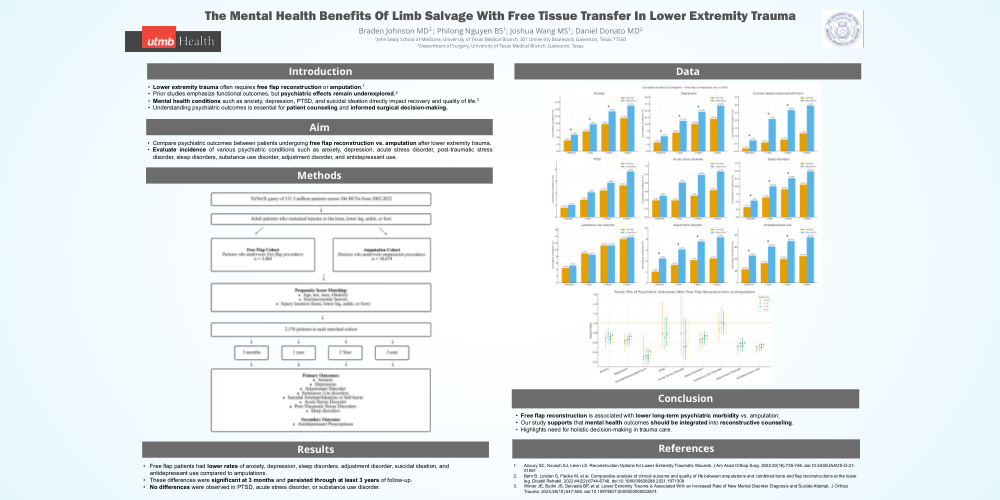
Introduction: Free tissue transfer is a major reconstructive tool in limb salvage for lower extremity trauma. While prior studies emphasize functional outcomes, psychiatric sequelae remain understudied. This study compares psychiatric outcomes after lower extremity free flap reconstruction versus amputation.
Methods: Patients ≥18 years with lower extremity injuries were identified in the TriNetX Research Network from 2002 to 2022. Cohorts were defined by either undergoing free tissue transfer or major lower extremity amputation. Using Internal Classification of Disease codes, the incidence of mental health conditions was examined. Propensity score matching controlled for patient demographics, socioeconomic factors, and injury location. Outcomes were assessed at 3 months, 1 and 3 years with hazard ratios (HR) and 95% confidence intervals (CI), significance p<0.05.
Results: Each matched cohort included 2,376 patients. At 3 months, flap patients had lower incidence of anxiety (3.8% vs 5.9%, HR 0.63, p=0.003), depression (3.3% vs 5.6%, HR 0.58, p=0.001), sleep disorders (3.3% vs 5.4%, HR 0.60, p=0.002), adjustment disorder (2.1% vs 4.5%, HR 0.46, p<0.0001), suicidal ideation (0.2% vs 0.7%, HR 0.25, p=0.008), and antidepressant use (11.4% vs 22.8%, HR 0.45, p<0.0001), with no differences in PTSD or substance use disorder. These differences persisted at 1–3 years for anxiety, depression, sleep disorders, adjustment disorder, suicidal ideation, and antidepressant use.
Conclusion: Free flap reconstruction was associated with lower psychiatric morbidity compared to amputation, with benefits persisting up to three years. Findings highlight the need to integrate mental health into reconstructive counseling. Prospective studies are warranted.