206 posters, 13 topics, 5 sessions, 713 authors, 293 institutions
ePostersLive by SciGen Technologies S.A. All rights reserved.
AAPS 104th Annual Meeting
May 2-5, 2026 | Lihue, HI

PC46
Frailty Predicts Postoperative Complications In Patients Undergoing Surgery For Diabetic Foot Ulcers
Part of Topic
Lower Extremity Reconstruction
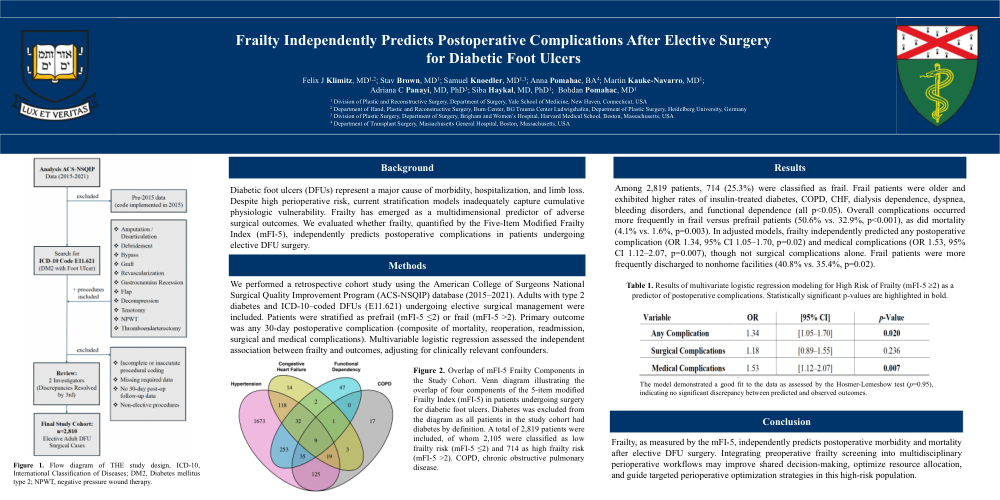
Background: Diabetic foot ulcers (DFUs) represent a major cause of morbidity, hospitalization, and limb loss. Despite high perioperative risk, current stratification models inadequately capture cumulative physiologic vulnerability. Frailty has emerged as a multidimensional predictor of adverse surgical outcomes. We evaluated whether frailty, quantified by the Five-Item Modified Frailty Index (mFI-5), independently predicts postoperative complications in patients undergoing elective DFU surgery.
Methods: We performed a retrospective cohort study using the American College of Surgeons National Surgical Quality Improvement Program (ACS-NSQIP) database (2015–2021). Adults with type 2 diabetes and ICD-10–coded DFUs (E11.621) undergoing elective surgical management were included. Patients were stratified as prefrail (mFI-5 ≤2) or frail (mFI-5 >2). Primary outcome was any 30-day postoperative complication (composite of mortality, reoperation, readmission, surgical and medical complications). Multivariable logistic regression assessed the independent association between frailty and outcomes, adjusting for clinically relevant confounders.
Results: Among 2,819 patients, 714 (25.3%) were classified as frail. Frail patients were older and exhibited higher rates of insulin-treated diabetes, COPD, CHF, dialysis dependence, dyspnea, bleeding disorders, and functional dependence (all p<0.05). Overall complications occurred more frequently in frail versus prefrail patients (50.6% vs. 32.9%, p<0.001), as did mortality (4.1% vs. 1.6%, p=0.003). In adjusted models, frailty independently predicted any postoperative complication (OR 1.34, 95% CI 1.05–1.70, p=0.02) and medical complications (OR 1.53, 95% CI 1.12–2.07, p=0.007), though not surgical complications alone. Frail patients were more frequently discharged to nonhome facilities (40.8% vs. 35.4%, p=0.02).
Conclusion: Frailty, as measured by the mFI-5, independently predicts postoperative morbidity and mortality after elective DFU surgery. Integrating preoperative frailty screening into multidisciplinary perioperative workflows may improve shared decision-making, optimize resource allocation, and guide targeted perioperative optimization strategies in this high-risk population.