206 posters, 13 topics, 5 sessions, 713 authors, 293 institutions
ePostersLive by SciGen Technologies S.A. All rights reserved.
AAPS 104th Annual Meeting
May 2-5, 2026 | Lihue, HI

PC20
Prophylactic Absorbable Antibiotic Beads And Peri-prosthetic Intracorporeal Chlorhexidine Washes In Implant-based Breast Reconstruction
Part of Topic
Breast Reconstruction
Prophylactic Absorbable Antibiotic Beads And Peri-prosthetic Intracorporeal Chlorhexidine Washes In Implant-based Breast Reconstruction
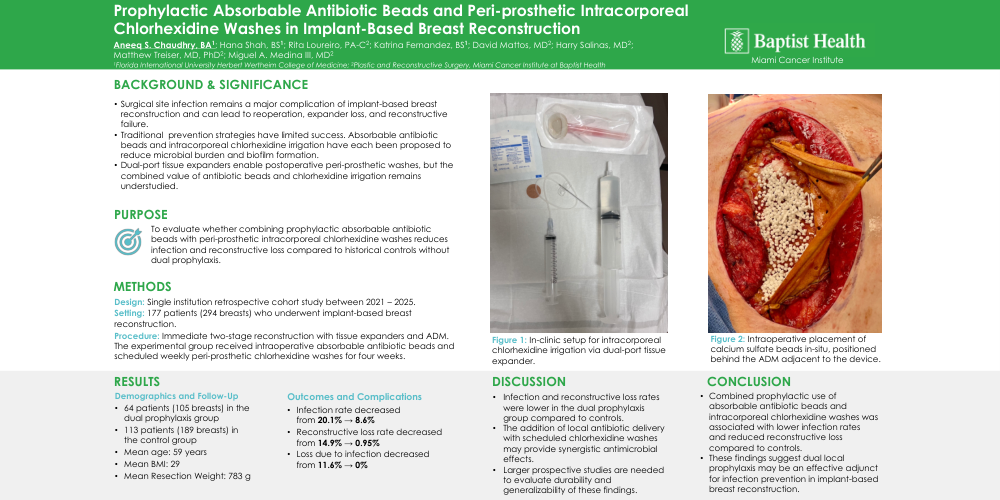
PURPOSE: Infection remains a major complication in implant-based breast reconstruction. This study aims to evaluate whether combining absorbable antibiotic beads with peri-prosthetic intracorporeal chlorhexidine washes reduces infection and reconstructive loss.
METHODS: This single-institution retrospective cohort study included patients undergoing primary implant-based breast reconstruction with partial subpectoral tissue expanders over one year (January-December 2024). All reconstructions used a contoured acellular dermal matrix (ADM) as an inferior pole sling, with the pectoralis major sewn to the ADM to create a retromuscular pocket. The experimental group received biodegradable calcium sulfate antibiotic beads (1g vancomycin, 240mg gentamicin) at expander insertion and weekly peri-prosthetic intracorporeal chlorhexidine washes for four weeks. Historical controls from the same institution (2021-2022) underwent the same technique without beads or washes. Both groups received perioperative and postoperative antibiotics.
RESULTS: A total of 42 patients (67 breasts) received dual prophylaxis, while 113 patients (189 breasts) served as controls. Mean age was 56.01 years, BMI 30.01, and mastectomy weight 813.5g. Infection occurred in 5.97% (4/67) of prophylaxis cases versus 20.1% (38/189) of controls (p < 0.01). Total reconstructive loss was 1.5% (1/67, secondary to soft-tissue failure) versus 14.9% (27/189) (p < 0.01). Of losses, 0% were infection-related in the prophylaxis group versus 11.6% (22/189) in controls. Among 4 infections, 3 resolved without surgery, and 1 was salvaged operatively.
CONCLUSION: Dual prophylaxis with antibiotic beads and peri-prosthetic intracorporeal chlorhexidine washes reduced infection and reconstructive loss. This approach may serve as an effective adjunct for infection prevention in breast cancer patients and merits further validation.