206 posters, 13 topics, 5 sessions, 713 authors, 293 institutions
ePostersLive by SciGen Technologies S.A. All rights reserved.
AAPS 104th Annual Meeting
May 2-5, 2026 | Lihue, HI

PC19
To Characterize The Timing And Risk Of Complications In Post-Mastectomy Radiation Therapy (RT) Patients During The First Stage Of Implant-Based Breast Reconstruction (IBBR)
Poster Presenter
Authors
Saïd Azoury, Timothy Olsen, Ariel Gabay, Aamirah McCutchen, Margaret Hornick, Robyn Broach, Tajah Bell, Evan Matros, Joseph Serletti, Robert Allen Jr., Suhail Kanchwala, Babak Mehrara, Jonas Nelson
Affiliations
University of Pennsylvania, University of Pennsylvania, Philadelphia, PA, Memorial Sloan Kettering Cancer Center, New York, NY
Part of Topic
Breast Reconstruction
Temporal Patterns of Complications Following Postmastectomy Radiation Therapy: A Multi-Institutional Study
Saïd C. Azoury¹, Timothy C. Olsen¹, Ariel Gabay², Aamirah I. McCutchen¹, Margaret M. Hornick¹, Robyn B. Broach¹, Tajah Bell², Evan Matros², Joseph M. Serletti¹, Robert J. Allen Jr.², Suhail K. Kanchwala¹, Babak J. Mehrara², Jonas A. Nelson²
¹ University of Pennsylvania, Philadelphia, PA; ² Memorial Sloan Kettering Cancer Center, New York, NY
Background:
The timing of when complications arise during the tissue expander (TE) phase relative to postmastectomy radiation therapy (PMRT) remains unclear.
Purpose:
Delineate PMRT complication risk when tissue expanders are in place.
Methods:
Retrospective, multi-institutional (2014–2025).
Breast-level analysis & PMRT aligned window.
Cox model with patient clustering (breast-level) to assess hazards of any complication spanning the start of PMRT → implant exchange.
Covariates: active PMRT, field, dose, fractions, age, BMI, hypertension, diabetes, and smoking status.
Results:
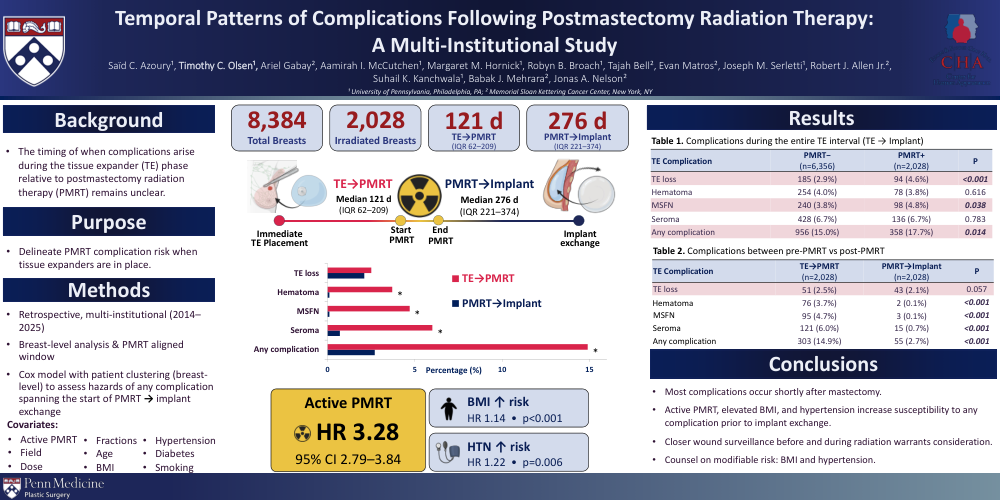
Among 8,384 breasts (PMRT- 6,356; PMRT+ 2,028), any TE complication occurred in 15.7% overall: (15.0% PMRT- vs 17.7% PMRT+, p=0.014).
MSFN occurred in 3.8% vs 4.8% (p=0.038) and TE loss in 2.9% vs 4.6% (p<0.001), in PMRT- vs. PMRT+, respectively, while neither hematoma nor seroma demonstrated a significant difference.
Within PMRT+ breasts, complications clustered before PMRT (14.9% TE-to-PMRT vs 2.7% PMRT-to-implant; p<0.001).
Time-dependent analysis demonstrated that active PMRT was associated with an elevated hazard of any complication (HR=3.28; 95% CI 2.79–3.84).
Increased hazard was also associated with elevated BMI (HR=1.14; p<0.001) and hypertension (HR=1.22; p=0.006).
PMRT dose, fractions, and course length were not significant.
Conclusions:
Most complications occur shortly after mastectomy.
Active PMRT, elevated BMI, and hypertension increase susceptibility to any complication prior to implant exchange.
Closer wound surveillance before and during radiation warrants consideration.
Counsel on modifiable risk: BMI and hypertension.