206 posters, 13 topics, 5 sessions, 713 authors, 293 institutions
ePostersLive by SciGen Technologies S.A. All rights reserved.
AAPS 104th Annual Meeting
May 2-5, 2026 | Lihue, HI

PC15
The Flap Gap: Disparities In Access To Autologous Breast Reconstruction And DIEP Flaps Following Mastectomy
Poster Presenter
Authors
Lee D. Yang, Nikhil A. Gangoli, Juliana M. Marquez, Michael B. Amrami, Christine H. Rohde, Jarrod T. Bogue
Affiliations
Columbia University Vagelos College of Physicians and Surgeons, Division of Plastic Surgery, Department of Surgery, New York-Presbyterian Hospital/ Columbia University Irving Medical Center
Part of Topic
Breast Reconstruction
Background: Autologous breast reconstruction is associated with superior body satisfaction and psychological well-being after oncological mastectomy compared with implant-based reconstruction. The deep inferior epigastric perforator (DIEP) flap is generally preferred due to lower donor site morbidity and postoperative complications. This study aims to characterize national trends and disparities in access to autologous reconstruction and DIEP flaps, with a focus on how these patterns have evolved over time.
Methods: The 2016-2022 National Inpatient Sample was queried to identify patients who underwent post-oncological breast reconstruction with autologous tissue or synthetic material. The weighted sample was analyzed to assess trends in flap and implant utilization. Multivariable logistic regression models with year-by-covariate interaction terms were used to assess temporal changes while adjusting for patient and hospital characteristics.
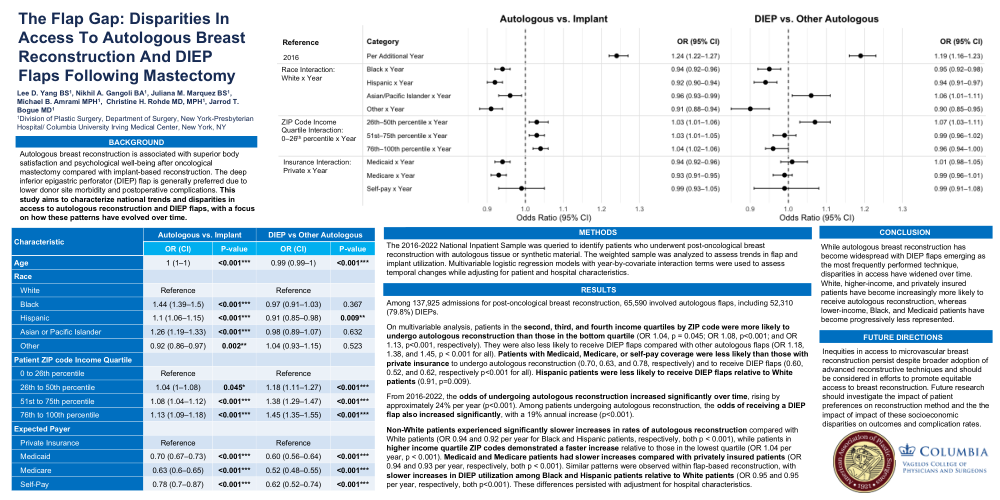
Results: Among 137,925 admissions for post-oncological breast reconstruction, 65,590 involved autologous flaps, including 52,310 (79.8%) DIEPs.
On multivariable analysis, patients in the second, third, and fourth income quartiles by ZIP code were more likely to undergo autologous reconstruction than those in the bottom quartile (OR 1.04, p = 0.045; OR 1.08, p<0.001; and OR 1.13, p<0.001, respectively). They were also less likely to receive DIEP flaps compared with other autologous flaps (OR 1.18, 1.38, and 1.45, p < 0.001 for all). Patients with Medicaid, Medicare, or self-pay coverage were less likely than those with private insurance to undergo autologous reconstruction (0.70, 0.63, and 0.78, respectively) and to receive DIEP flaps (0.60, 0.52, and 0.62, respectively p<0.001 for all). Hispanic patients were less likely to receive DIEP flaps relative to White patients (0.91, p=0.009).
From 2016-2022, the odds of undergoing autologous reconstruction increased significantly over time, rising by approximately 24% per year (p<0.001). Among patients undergoing autologous reconstruction, the odds of receiving a DIEP flap also increased significantly, with a 19% annual increase (p<0.001).
Non-White patients experienced significantly slower increases in rates of autologous reconstruction compared with White patients (OR 0.94 and 0.92 per year for Black and Hispanic patients, respectively, both p < 0.001), while patients in higher income quartile ZIP codes demonstrated a faster increase relative to those in the lowest quartile (OR 1.04 per year, p < 0.001). Medicaid and Medicare patients had slower increases compared with privately insured patients (OR 0.94 and 0.93 per year, respectively, both p < 0.001). Similar patterns were observed within flap-based reconstruction, with slower increases in DIEP utilization among Black and Hispanic patients relative to White patients (OR 0.95 and 0.95 per year, respectively, both p<0.001). These differences persisted with adjustment for hospital characteristics.
Conclusion: While autologous breast reconstruction has become widespread with DIEP flaps emerging as the most frequently performed technique, disparities in access have widened over time. White, higher-income, and privately insured patients have become increasingly more likely to receive autologous reconstruction, whereas lower-income, Black, and Medicaid patients have become progressively less represented.
Future Directions: Inequities in access to microvascular breast reconstruction persist despite broader adoption of advanced reconstructive techniques and should be considered in efforts to promote equitable access to breast reconstruction.
Future research should investigate the impact of patient preferences on reconstruction method and the the impact of impact of these socioeconomic disparities on outcomes and complication rates.