206 posters, 13 topics, 5 sessions, 713 authors, 293 institutions
ePostersLive by SciGen Technologies S.A. All rights reserved.
AAPS 104th Annual Meeting
May 2-5, 2026 | Lihue, HI

PC14
Assessing The Outcomes: Complication Rates In Immediate Breast Reconstruction By Nonplastic Surgeons - A Nationwide Analysis
Part of Topic
Breast Reconstruction
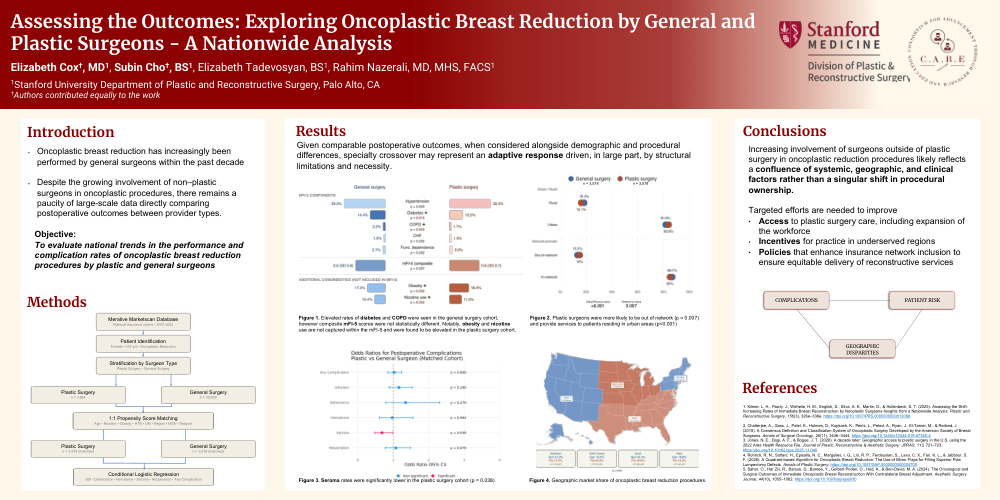
Assessing the Outcomes: Exploring Oncoplastic Breast Reduction by General and Plastic Surgeons - A Nationwide Analysis
Subin Cho, BS1, Elizabeth Tadevosyan, BS1, Elizabeth Cox, MD1, Rahim Nazerali, MD1
1Stanford University, Division of Plastic and Reconstructive Surgery
Introduction: Recent studies have highlighted a shifting landscape in oncoplastic breast reconstruction by nonplastic surgeons. These changes may have important implications for patient safety and reconstructive outcomes. While prior work has described utilization trends, complication profiles remain incompletely characterized. This study aims to explore the risks of oncoplastic reduction procedures by surgeon type, providing insights to support informed clinical decisions and patient outcomes.
Method: A national insurance database (Merative Marketscan) was queried to identify female patients ≥18 years old undergoing oncologic breast reduction from 2007 to 2023. Patients were stratified by surgeon type, including general or plastic surgeons. 1:1 propensity score matching was performed using age, nicotine use, obesity, hypertension, diabetes, region, metropolitan statistical area, and network coverage as covariates. Complication rates (surgical site infection, dehiscence, hematoma, seroma, reoperation, any complication) were compared between matched cohorts using conditional logistic regression.
Results: 43,684 oncoplastic breast reduction claims were included. Patients treated by plastic surgeons were younger (p < 0.001), more obese (p = 0.004), more likely to reside in urban areas (p < 0.001), and more frequently had out-of-network coverage for their procedure (p = 0.007). Propensity score matching yielded 7,156 patients (3,578 per general surgery and plastic surgery cohort). Plastic surgeons demonstrated decreased odds of post-operative seroma (OR 0.68, 95% CI: 0.47-0.98, p = 0.038). Odds of any complication, infection, dehiscence, hematoma, and reoperation were not significantly different between cohorts.
Conclusions: Differences in complications between plastic and general surgeons were comparable, with a notable exception of reduced seroma risk in the plastic surgery cohort. This suggests that specialized training in soft tissue management may influence operative techniques and postoperative care principles to confer a slight advantage in acute postoperative outcomes. As the utilization of oncoplastic breast reduction continues to expand, the increasing involvement of surgeons outside of plastic surgery likely reflects a confluence of systemic, geographic, and clinical factors rather than a singular shift in procedural ownership. Addressing disparities in access to plastic surgeons, particularly in rural and underserved regions, will be critical to ensuring equitable delivery of reconstructive care while maintaining high standards of aesthetic and functional outcomes.