206 posters, 13 topics, 5 sessions, 713 authors, 293 institutions
ePostersLive by SciGen Technologies S.A. All rights reserved.
AAPS 104th Annual Meeting
May 2-5, 2026 | Lihue, HI

PC12
Tone Matters: Psycholinguistic Shifts In Chatgpt Responses To Post-Mastectomy Breast Reconstruction Concerns
Poster Presenter
Part of Topic
Breast Reconstruction
Introduction
Patients are increasingly using large language model chatbots such as ChatGPT to ask questions about breast reconstruction. Although factual accuracy remains a concern, less is known about how the tone of a patient’s question influences the style and content of the response.
Methods
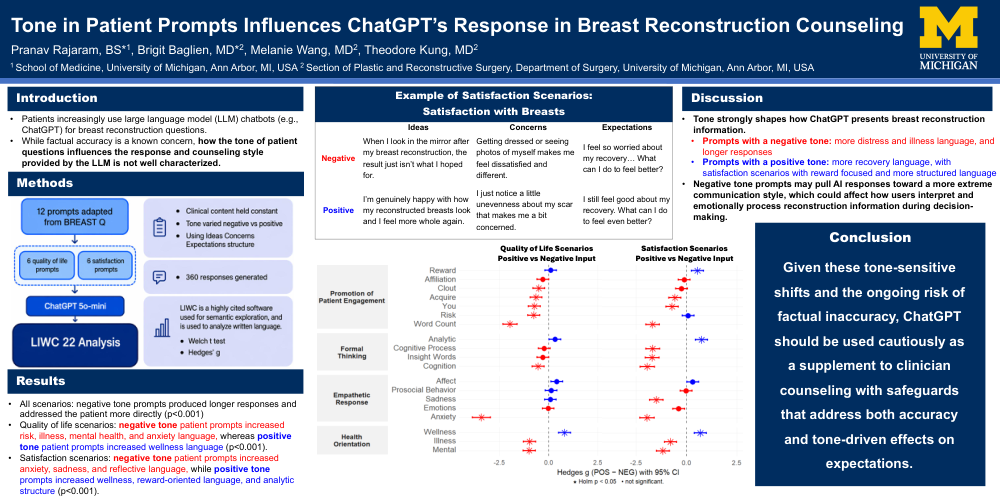
Twelve prompts were adapted from BREAST-Q breast reconstruction outcomes, with six focused on quality of life and six on satisfaction. Clinical content was held constant while patient question tone was varied as negative or positive using the Ideas, Concerns, and Expectations framework. Prompts were submitted to a free ChatGPT account using GPT-5o mini, generating 360 responses. Outputs were analyzed with LIWC-22, a reliable and widely used language analysis program, across four domains including patient engagement, health orientation, empathetic response, and formal thinking. Results were compared using Welch’s t tests with Holm correction and Hedges’ g.
Results
Across all scenarios, negatively toned prompts produced longer responses and more direct patient address than positively toned prompts, with p<0.001. In quality of life scenarios, negative prompts increased risk, illness, mental health, and anxiety language, while positive prompts increased wellness language, with p<0.001. In satisfaction scenarios, negative prompts increased anxiety, sadness, and reflective language, whereas positive prompts increased wellness language, reward-oriented language, and analytic structure, with p<0.001.
Discussion
Prompt tone had a strong effect on how ChatGPT presented breast reconstruction information. Negative prompts elicited longer responses that used more distress-related and illness-related language. Positive prompts elicited more recovery-oriented language and, in satisfaction scenarios, more reward-focused and analytically structured responses. These findings suggest that negative prompt tone may push AI-generated counseling toward a more emotionally intensified communication style, which could influence how patients interpret reconstruction information and form expectations during decision making.
Conclusion
Because ChatGPT responses shift with prompt tone and remain vulnerable to factual inaccuracy, its use in breast reconstruction counseling should be approached cautiously. It may serve as a supplement to clinician counseling, but safeguards are needed to address both accuracy and tone-driven effects on patient expectations.