206 posters, 13 topics, 5 sessions, 713 authors, 293 institutions
ePostersLive by SciGen Technologies S.A. All rights reserved.
AAPS 104th Annual Meeting
May 2-5, 2026 | Lihue, HI

D112
Patient Priorities In Breast Sensation Among Patients Undergoing Breast Reconstruction
Poster Presenter
Authors
Lily Zhu, Ganiat Giwa, Kimberly Khoo, Steven Zeng, Lily Mundy
Affiliations
Part of Topic
Breast Reconstruction
Introduction
- Breast reconstruction restores form and function after mastectomy, but sensory loss is common
- Up to 80% of patients experience sensory loss
- Breast sensation impacts body image, sexual function, psychological well-being, quality of life, and satisfaction
- Surgical strategies to improve sensation include nipple/flap innervation and nerve optimization (preservation, coaptation, grafting)
- Limited data exist on which sensation types matter most to patients and how sensation influences decision-making
Objective
Assess patient priorities regarding breast sensation, its perceived importance in decision-making, awareness of nerve optimization, and associations with postoperative satisfaction
Methods
- Online survey distributed via breast cancer communities (Breast of Us, Tower Collective, DIEP C Foundation Facebook group), April 2024–July 2025
- Inclusion: Female, ≥18 years, history of breast reconstruction for breast cancer
- Primary outcomes:
- BREAST-Q Satisfaction with Breasts (0–100)
- BREAST-Q Satisfaction with Information (0–100)
- Statistical analysis: Descriptive statistics, independent t-tests, multivariable linear regression (adjusted for age, cancer stage, income, mastectomy type, and time since reconstruction)
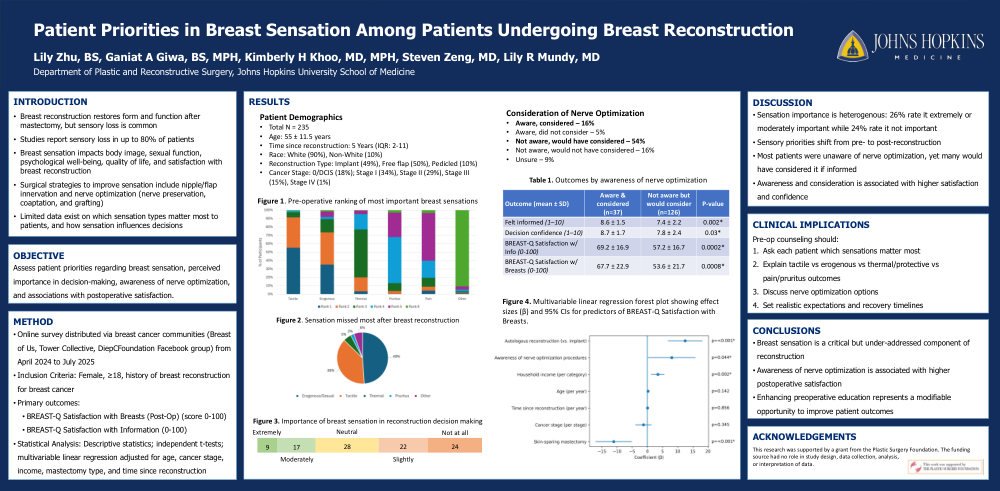
Patient Demographics
- N = 235
- Age: 55 ± 11.5 years
- Time since reconstruction: 5 years (IQR: 2–11)
- Race: White (90%), Non-White (10%)
- Reconstruction type: Implant (49%), Free flap (50%), Pedicled (10%)
- Cancer stage: 0/DCIS (18%), Stage I (34%), Stage II (29%), Stage III (15%), Stage IV (1%)
Consideration of Nerve Optimization
- Aware and considered: 16%
- Aware, did not consider: 5%
- Not aware, would have considered: 54%
- Not aware, would not have considered: 16%
- Unsure: 9%
Discussion
- Importance of sensation is heterogeneous: 26% rate it moderately/extremely important, while 24% rate it not important
- Sensory priorities shift from pre- to post-reconstruction
- Most patients were unaware of nerve optimization, yet many would have considered it if informed
- Awareness and consideration are associated with higher satisfaction and decision confidence
Clinical Implications
Preoperative counseling should:
- Ask which sensations matter most to each patient
- Explain types of sensation (tactile, erogenous, thermal/protective, pain/pruritus)
- Discuss nerve optimization options
- Set realistic expectations and recovery timelines
Conclusions
- Breast sensation is a critical but under-addressed component of reconstruction
- Awareness of nerve optimization is associated with higher postoperative satisfaction
- Improving preoperative education represents a modifiable opportunity to enhance patient outcomes