206 posters, 13 topics, 5 sessions, 713 authors, 293 institutions
ePostersLive by SciGen Technologies S.A. All rights reserved.
AAPS 104th Annual Meeting
May 2-5, 2026 | Lihue, HI

PC11
Length Of Stay In Free Flap Breast Reconstruction Has Declined 31%: A 16-year Acs-nsqip Big Data Study Of 21,777 Cases
Poster Presenter
Authors
Georgios Karamitros, Armin Catic, Michael Lamaris, Sebastiano Barbieri, Luisa Jorm, Gregory Lamaris
Affiliations
Vanderbilt University, Center for Big Data Research in Health, University of New South Wales, Sydney, Australia, Division of Plastic and Reconstructive Surgery, R. Adams Cowley Shock Trauma Center, University of Maryland Medical Center, Baltimore, MD, USA, Queensland Digital Health Center, University of Queensland, Brisbane, QLD, Australia
Part of Topic
Breast Reconstruction
Background:
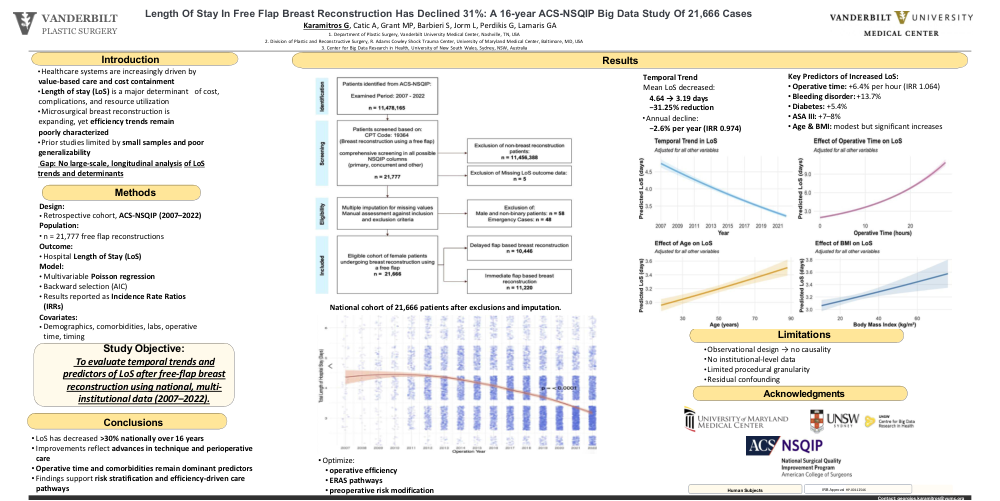
Length of stay (LoS) is a key driver of cost, complications, and resource utilization in microsurgical breast reconstruction. Despite advances in technique and perioperative care, national trends and determinants of LoS remain incompletely characterized.
Methods:
We performed a retrospective analysis of the ACS-NSQIP database (2007–2022), including 21,666 patients undergoing free-flap breast reconstruction. Multivariable Poisson regression with backward selection (AIC) was used to identify predictors of LoS, reported as incidence rate ratios (IRRs).
Results:
Mean LoS decreased from 4.64 to 3.19 days (−31.25%) over the study period, with a 2.6% annual reduction (IRR 0.974). Longer operative time (+6.4% per hour), bleeding disorders (+13.7%), diabetes (+5.4%), and higher ASA class were associated with prolonged LoS. Age and BMI demonstrated modest but significant effects.
Conclusions:
LoS after free-flap breast reconstruction has decreased substantially over the past 16 years, reflecting improvements in surgical and perioperative care. Operative time and comorbidity burden remain dominant predictors, supporting targeted optimization and efficiency-driven care pathways.