206 posters, 13 topics, 5 sessions, 713 authors, 293 institutions
ePostersLive by SciGen Technologies S.A. All rights reserved.
AAPS 104th Annual Meeting
May 2-5, 2026 | Lihue, HI

D98
Preoperative Perforator Mapping Reduces 90-Day Unplanned Reoperation After DIEP Flap Breast Reconstruction
Poster Presenter
Authors
Sahil Sharma, Sheuli Chowdhury, Martha MacDonald, Patricia Fuentes, Emma Lascar, Alexander Kagen, Alice Yao, Peter Taub, Peter Henderson
Affiliations
Division of Plastic and Reconstructive Surgery, Icahn School of Medicine at Mount Sinai, Division of Plastic and Maxillofacial Surgery, Icahn School of Medicine at Mount Sinai, Division of Diagnostic, Molecular and Interventional Radiology, Icahn School of Medicine at Mount Sinai
Part of Topic
Breast Reconstruction
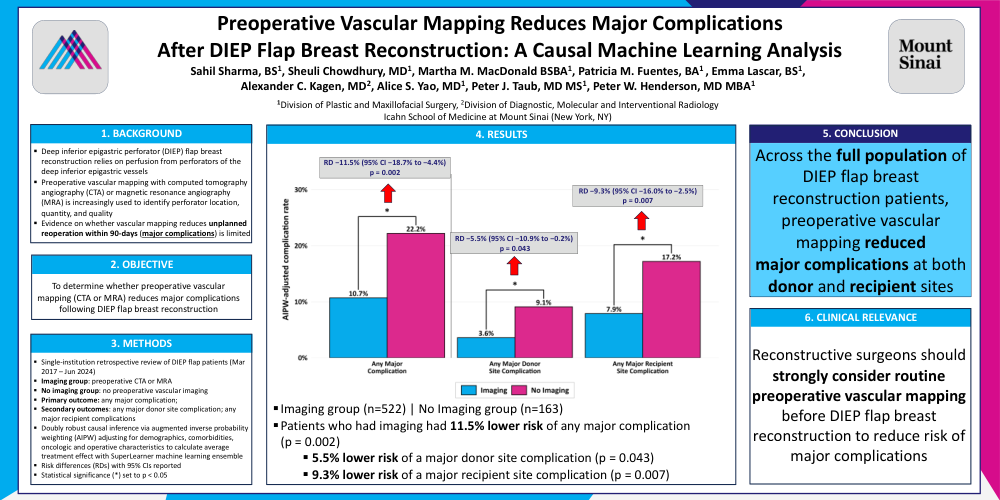
Preoperative Vascular Mapping Reduces Major Complications After DIEP Flap Breast Reconstruction: A Causal Machine Learning Analysis
Sahil Sharma, BS1, Sheuli Chowdhury, MD1, Martha M. MacDonald BSBA1,Patricia M. Fuentes, BA1 ,Emma Lascar, BS1, Alexander C. Kagen, MD2, Alice S. Yao, MD1, Peter J. Taub, MD MS1, Peter W. Henderson, MD MBA1
1Division of Plastic and Maxillofacial Surgery, 2Division of Diagnostic, Molecular and Interventional Radiology
Icahn School of Medicine at Mount Sinai (New York, NY)
1. BACKGROUND
To determine whether preoperative vascular mapping (CTA or MRA) reduces major complications following DIEP flap breast reconstruction
3. METHODS
(p = 0.002)
donor and recipient sites
6. CLINICAL RELEVANCE
Reconstructive surgeons should strongly consider routine preoperative vascular mappingbefore DIEP flap breast reconstruction to reduce risk of major complications