206 posters, 13 topics, 5 sessions, 713 authors, 293 institutions
ePostersLive by SciGen Technologies S.A. All rights reserved.
AAPS 104th Annual Meeting
May 2-5, 2026 | Lihue, HI

D74
Atopic Disease As A Risk Factor For Implant-related Complications In Breast Reconstruction
Poster Presenter
Authors
Philong Nguyen, Doruk Orgun, Yousef Tanas, Myiah Quach, Joshua Wang, Samuel Poore
Affiliations
UTMB, University of Texas Medical Branch, 301 University Boulevard, Galveston, Texas, USA, Division of Plastic Surgery, University of Wisconsin, 600 Highland Ave, Madison, WI, Institute for Reconstructive Surgery, Houston Methodist Hospital, Weill Cornell Medicine, Texas, USA, Health Sciences Learning Center, 750 Highland Ave, Madison, WI, USA
Part of Topic
Aesthetic Breast/Body Contouring
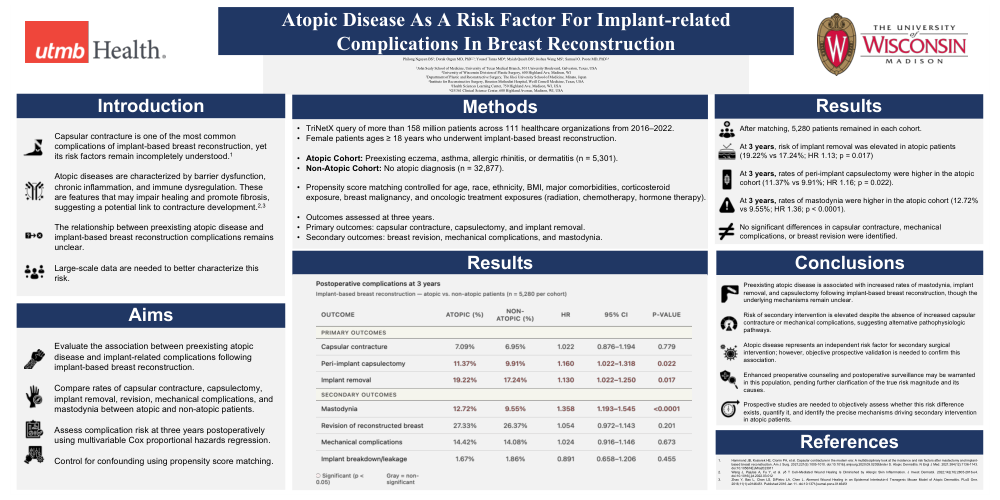
Atopic Disease As A Risk Factor For Implant-related Complications In Breast Reconstruction
Philong Nguyen, Doruk Orgun, Yousef Tanas, Myiah Quach, Joshua Wang, Samuel O. Poore
Keywords: atopic disease, breast reconstruction, implant complications, capsular contracture, capsulectomy, implant removal, mastodynia, eczema, asthma, allergic rhinitis, dermatitis, propensity score matching, TriNetX, plastic surgery, reconstructive surgery
Abstract:
Capsular contracture is one of the most common complications of implant-based breast reconstruction. This study evaluated whether preexisting atopic disease, including eczema, asthma, allergic rhinitis, and dermatitis, is associated with increased implant-related complications following breast reconstruction.
Using a TriNetX query of over 158 million patients across 111 healthcare organizations from 2016 to 2022, we identified female patients who underwent implant-based breast reconstruction. After propensity score matching, 5,280 patients remained in each cohort. At three years, atopic patients had significantly higher rates of implant removal (19.22% vs 17.24%; HR 1.13), peri-implant capsulectomy (11.37% vs 9.91%; HR 1.16), and mastodynia (12.72% vs 9.55%; HR 1.36). No significant differences were found in capsular contracture, mechanical complications, or breast revision.
Atopic disease represents an independent risk factor for secondary surgical intervention following implant-based breast reconstruction. The underlying mechanisms remain unclear, as capsular contracture does not appear to be the primary driver. Prospective studies are needed to confirm this association and identify causative pathways.
Institutions: University of Texas Medical Branch, University of Wisconsin Division of Plastic Surgery, Houston Methodist Hospital, Weill Cornell Medicine