206 posters, 13 topics, 5 sessions, 713 authors, 293 institutions
ePostersLive by SciGen Technologies S.A. All rights reserved.
AAPS 104th Annual Meeting
May 2-5, 2026 | Lihue, HI

D29
Use Of Drains In Breast Reduction Surgery Has An Increased Complication Risk In Select Patient Subgroups Based On A Stratified Analysis Of A Large Retrospective Cohort
Part of Topic
Aesthetic Breast/Body Contouring
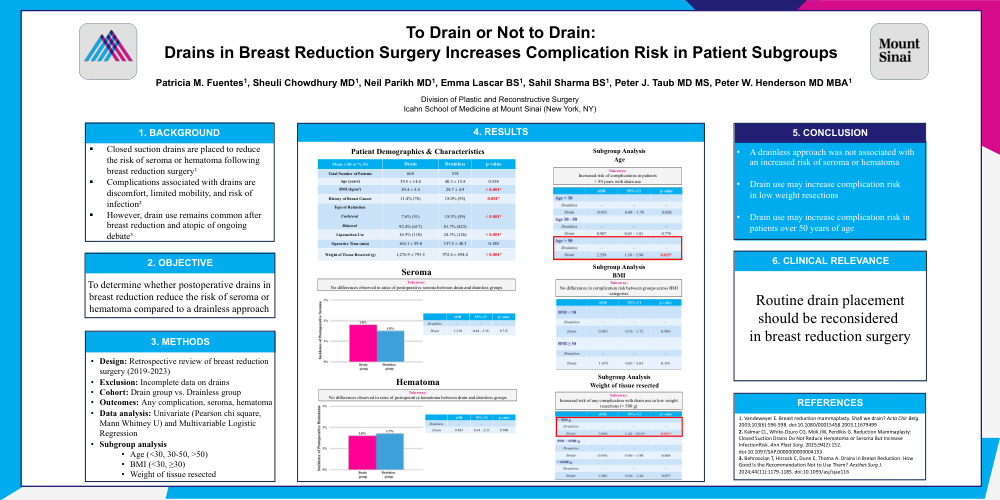
To Drain or Not to Drain: Drains in Breast Reduction Surgery Increases Complication Risk in Patient Subgroups
Patricia M. Fuentes1, Sheuli Chowdhury MD1, Neil Parikh MD1, Emma Lascar BS1, Sahil Sharma BS1, Peter J. Taub MD MS, Peter W. Henderson MD MBA1
1 Division of Plastic and Reconstructive Surgery, Icahn School of Medicine at Mount Sinai
Introduction
The use of closed-suction drains after breast reduction varies among plastic surgeons. Its indication is to limit fluid accumulation thus theoretically reducing postoperative seroma or other complications, but their efficacy remains controversial. Recent guidelines suggest that drains may not provide significant benefit and are associated with patient discomfort, limited mobility, and infection risk. This study evaluated risk factors linked to higher complications following drain placement in breast reduction surgery.
Methods
All female patients undergoing breast reduction at a single academic center (2019–2023) were included. Patients were stratified into drain and drainless cohorts. Demographics, comorbidities, operative variables, and postoperative complications were collected. The primary outcome was any complication (seroma, fat necrosis, wound dehiscence, cellulitis, nipple necrosis, hematoma, revision). Stratified logistic regressions were performed by patient comorbidities (BMI, diabetes, hypertension, hyperlipidemia, smoking history, breast cancer history) and operative variables (laterality, resection weight, technique, liposuction). Outcomes were compared with Pearson chi-square and Mann–Whitney U tests; multivariable logistic regression adjusted for confounders. Significance was set at p<0.05.
Results
Among 1,186 patients, 668 (56.3%) had drains and 518 (43.7%) did not. Cohorts differed in BMI, race, insurance, laterality, technique, liposuction use, and resected weight (p<0.05). Complication rates were similar (14.4% with drains vs 13.1% without, p=0.555). Drains were significantly associated with an increased risk of complications in patients with hypertension (OR 4.33, 95% CI 1.34–13.95, p=0.014), history of breast cancer (OR 5.35, 95% CI 1.46–19.59, p=0.011), age >51 years (OR 2.56, 95% CI 1.10–5.94, p=0.029), and tissue weight resections <500 g (OR 5.04, 95% CI 1.24–20.47, p=0.023).
Conclusion
Drains may pose additional complication risk in individuals undergoing breast reduction surgery with hypertension, history of breast cancer, older age, and lower weight of tissue resection. Additional caution should be taken if considering drain placement with these patients.