206 posters, 13 topics, 5 sessions, 713 authors, 293 institutions
ePostersLive by SciGen Technologies S.A. All rights reserved.
AAPS 104th Annual Meeting
May 2-5, 2026 | Lihue, HI

D28
Superomedial Pedicle Technique Is Associated With Fewer Complications Compared To The Inferior Pedicle Technique In High-volume Reduction Mammaplasty
Part of Topic
Aesthetic Breast/Body Contouring
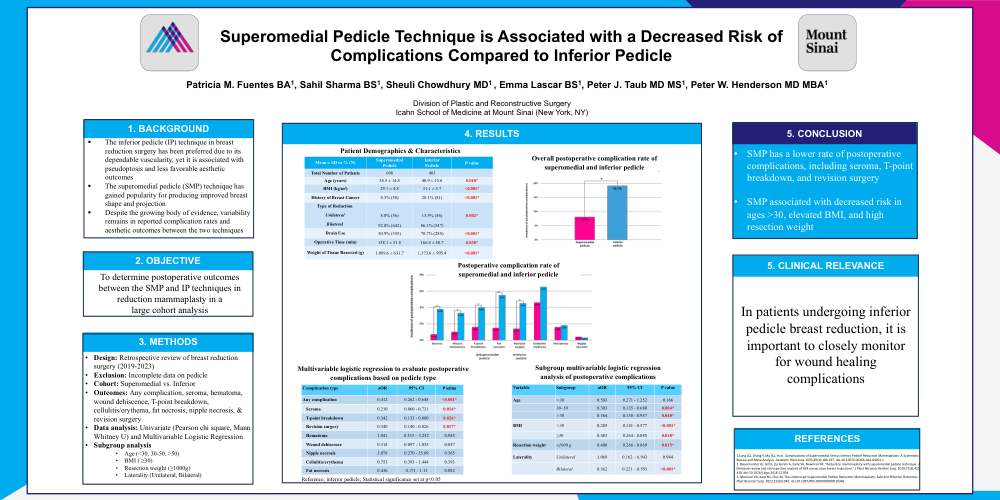
Superomedial Pedicle Technique is Associated with a Decreased Risk of Complications Compared to Inferior Pedicle
Patricia M. Fuentes BA1, Sahil Sharma BS1, Sheuli Chowdhury MD1 , Emma Lascar BS1, Peter J. Taub MD MS1, Peter W. Henderson MD MBA1
1 Division of Plastic and Reconstructive Surgery, Icahn School of Medicine at Mount Sinai (New York, NY)
Background
Breast reduction surgery in patients with symptomatic macromastia can significantly improve quality of life. Traditionally, inferior pedicle (IP) breast reduction has been the preferred technique in patients with a high degree of ptosis and macromastia due to its perceived vascular reliability. However, the IP technique has been shown to result in unfavorable aesthetic results including unsightly scars and pseudoptosis. The superomedial pedicle (SMP) technique has gained acceptance due to its more favorable aesthetic profile, however its safety in patients with high volume breast reduction is understudied. Therefore, this study compares outcomes between IP and SMP in patients undergoing high volume breast reduction.
Methods
All female patients undergoing high volume breast reduction (≥1000 g) at a single academic center (2019–2023) were included. Patients were stratified into IP and SMP cohorts. Demographics, comorbidities, operative variables, and postoperative complications were collected. Outcomes were postoperative T-point breakdown, wound dehiscence, fat necrosis, nipple necrosis, cellulitis, seroma, hematoma, and revision. Pearson chi-square and Mann–Whitney U tests were used to compare cohorts, and multivariable logistic regression adjusted for confounders. Significance was set at p<0.05.
Results
Among 578 patients, 344 (58.2%) had SMP and 234 (39.6%) had IP. Baseline differences included BMI, race, and insurance (p<0.05). Overall complication rate was significantly lower in the SMP group (7.8%) compared with IP (18.3%) (p<0.001). Fat necrosis (SMP 0.6% vs IP 4.8%, p=0.001), T-point breakdown (2.4% vs 4.4%, p=0.188), wound dehiscence (1.2% vs 3.5%, p=0.078), seroma (0.9% vs 2.6%, p=0.169), cellulitis (4.9% vs 7.7%, p=0.174) and revisions (1.2% vs 5.3%, p=0.005) were all also decreased in the SMP cohort. Nipple necrosis (SMP 0.4% vs IP 0%, p=0.517) and hematoma (2.4% vs 1.7%, p=0.770) were increased in the SMP cohort, although this was not statistically significant.
Conclusion
The superomedial technique is associated with a low complication profile in patients undergoing high volume breast reduction. Relative to the inferior pedicle technique, the superomedial pedicle is a safe alternative.