206 posters, 13 topics, 5 sessions, 713 authors, 293 institutions
ePostersLive by SciGen Technologies S.A. All rights reserved.
AAPS 104th Annual Meeting
May 2-5, 2026 | Lihue, HI

D69
Association Of Cannabis Use With Postoperative Complications Following Panniculectomy: A Multicenter Propensity-matched Analysis
Poster Presenter
Authors
Jonathan Mokhtar, John Ha, Victor Almeida, Alexandre Lellouch, Krishna Vyas, Susan Doh, Eliana Duraes
Affiliations
Mohammed Bin Rashid University of Medicine and Health Sciences, School of Medicine, Case Western Reserve University, Cleveland, OH, USA, Department of Anesthesiology Research Integrated Hospital-Care, Cleveland Clinic, Cleveland, OH, USA, Division of Plastic and Reconstructive Surgery, Cedars Sinai Hospital, Los Angeles, USA; Université Paris Cité, Breast Surgery Group, New York, New York, USA; Department of Plastic Surgery, Manhattan Eye, Ear and Throat Hospital and Lenox Hill Hospital, New York, New York, USA, Department of Surgery, University Hospitals Cleveland Medical Center, Cleveland, OH, USA, Department of Plastic Surgery, Institute of Dermatology and Plastic Surgery, Cleveland Clinic, Cleveland, OH, USA
Part of Topic
Aesthetic Breast/Body Contouring
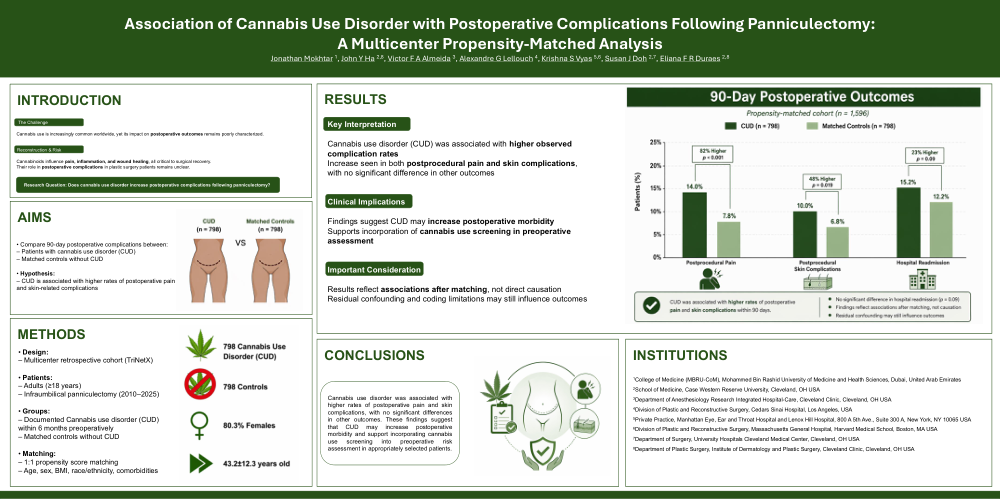
Background: As cannabis use continues to rise globally, its impact on surgical outcomes remains poorly characterized. Cannabinoids modulate immune, nociceptive, and vascular pathways, with implications for postoperative healing. This study aimed to evaluate whether cannabis use disorder (CUD) is independently associated with increased complications following infraumbilical panniculectomy.
Methods: A retrospective cohort study was conducted using the TriNetX Research Network, a globally federated database of de-identified electronic health records from over 100 healthcare organizations. Adult patients (≥18 years) who underwent infraumbilical panniculectomy between 2010 and 2025 were identified. Patients with CUD documented 6 months preoperatively were propensity score-matched 1:1 to non-users by age, sex, BMI, race or ethnicity, and comorbidities. Relative risks (RR) with 95% confidence intervals (CIs) were calculated for postoperative complications within 90 days.
Results: The mean age of the cohort was 43.2±12.3 years, with 80.3% of participants identifying as female. Among 1,596 matched patients (798 CUD; 798 controls), the CUD cohort exhibited significantly higher rates of postprocedural pain (RR 1.82, 95% CI [1.32–2.46]; p < 0.001) and postprocedural skin complications (RR 1.48, 95% CI [1.05–2.09]; p = 0.019) compared with controls. No statistically significant differences were observed in rates of sepsis, hematoma or seroma, venous embolism or thrombosis, pulmonary embolism, and hospital readmission.
Conclusions: Cannabis use disorder is independently associated with increased postoperative pain and wound-related complications following panniculectomy. Surgeons should incorporate cannabis use screening into preoperative risk assessments, particularly in procedures with high soft tissue demand. Limitations include reliance on ICD coding, lack of data on cannabis route or dose, and potential confounding from concurrent nicotine use.