206 posters, 13 topics, 5 sessions, 713 authors, 293 institutions
ePostersLive by SciGen Technologies S.A. All rights reserved.
AAPS 104th Annual Meeting
May 2-5, 2026 | Lihue, HI

D67
Patient Reported Outcome Measures Following Breast Reconstruction: A Systematic Review And Meta-analysis Utilizing The Breast-Q
Poster Presenter
Authors
Jonathan Mokhtar, Fatemeh Akbarpoor, Karen Blanco, Emanuele Batista, Hanin Al-Kilani, Guilherme Machado, Juliana Oliveria, Abanob Attalah, Sara Vidha, Lucas Kreutz-Rodrigues, Aparna Vijayasekaran, Alexandre Lellouch, Curtis Cetrulo, Krishna Vyas, Mario Cherubino, Raffi Gurunian
Affiliations
Mohammed Bin Rashid University of Medicine and Health Sciences, Division of Plastic and Reconstructive Surgery, Cedars Sinai Hospital, Los Angeles, USA, Division of Plastic and Reconstructive Surgery, Cedars Sinai Hospital, Los Angeles, USA; Université Paris Cité, Hospital Santa Marcelina, São Paulo, Brazil, Department of Plastic Surgery, Surgical Subspecialty Institute, Cleveland Clinic Abu Dhabi, Abu Dhabi, United Arab Emirates, Universidade do Estado do Rio de Janeiro, Faculdade de Ciências Médicas, Rio de Janeiro, Brazil, Faculty of Medicine, Vision College, Riyadh, Saudi Arabia, Department of Gynecology and Obstetrics, Federal University of Minas Gerais, Av.A Pres. Antônio Carlos, 6627 – Pampulha, Belo Horizonte, MG, 31270-901, Brazil, University of Missouri Kansas City School of Medicine, Missouri, TX, USA, Division of Plastic Surgery, Mayo Clinic, MN, United States, Breast Surgery Group, New York, New York, USA; Department of Plastic Surgery, Manhattan Eye, Ear and Throat Hospital and Lenox Hill Hospital, New York, USA
Part of Topic
Aesthetic Breast/Body Contouring
Background
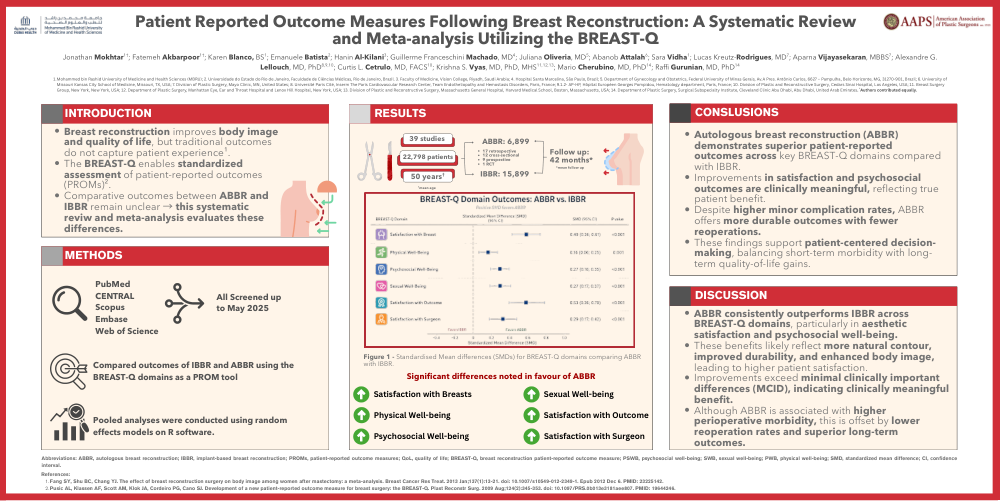
Patient-reported outcome measures (PROMs) play a crucial role in evaluating the success of breast reconstruction. The BREAST-Q provides a standardized measure of satisfaction and quality of life; however, comparative outcomes between autologous– and implant-based breast reconstruction (ABBR and IBBR) remain incompletely defined. This meta-analysis compared PROMs between ABBR and IBBR using the BREAST-Q.
Methods
A systematic search of PubMed, Embase, Scopus, Web of Science, and CENTRAL was conducted from database inception through May 2025. Studies comparing PROMs using the BREAST-Q in patients undergoing ABBR vs. IBBR were included. Pooled analyses were performed using a random-effects model, risk of bias was assessed with ROBINS-I and RoB 2.0, and certainty of evidence was assessed with GRADE.
Results
Thirty-nine studies comprising 22,798 patients (6,899 ABBR; 15,899 IBBR) were included. ABBR was associated with significantly higher satisfaction with breasts (SMD, 0.49; 95% CI [0.36–0.61]; p < 0.001), psychosocial well-being (SMD, 0.27; 95% CI [0.18–0.35]; p < 0.001), satisfaction with outcome (SMD, 0.53; 95% CI [0.36–0.70]; p < 0.001), and sexual well-being (0.27; 95% CI [0.17–0.37]; p < 0.001). Physical well-being differences were modest (SMD, 0.16; 95% CI [0.06–0.25]; p = 0.001). ABBR was associated with higher rates of minor complications (OR 2.44) but lower reoperation rates (OR 0.38).
Conclusion
Autologous reconstruction was associated with higher patient-reported outcome measures and clinically meaningful advantages in the aesthetic and overall outcome domains. These findings support individualized reconstructive decision-making that balances early morbidity against long-term quality-of-life benefit.