241 posters, 10 topics, 7 sessions, 899 authors, 296 institutions
ePostersLive by SciGen Technologies S.A. All rights reserved.
The AAPS 103rd Annual Meeting 2025
May 24-27, 2025 | Austin, Texas

P54
Increasing Number Of Cleft-related Surgeries Results In Worsened Maxillary Hypoplasia: A Cephalometric Study
Poster Presenter
Authors
Michael Edgar, Megan M. Perez, Akriti Choudhary, Isabella Zorra, Kelsey M. Green, Linping Zhao, Chad A. Purnell
Affiliations
University of Illinois College of Medicine at Chicago, Division of Plastic, Reconstructive & Cosmetic Surgery, University of Illinois at Chicago, Division of Plastic and Reconstructive Surgery, Northwestern University, Feinberg School of Medicine, Division of Plastic Surgery; Shriners Children's Hospital of Chicago, University of Illinois at Chicago, Division of Plastic and Reconstructive Surgery; Shriners Children's Hospital of Chicago, University of Illinois at Chicago; Shriners Children's Hospital of Chicago
Part of Topic
Craniofacial/Peds
Increasing Number of Cleft-Related Surgeries Results in Worsened Maxillary Hypoplasia: A Cephalometric Study
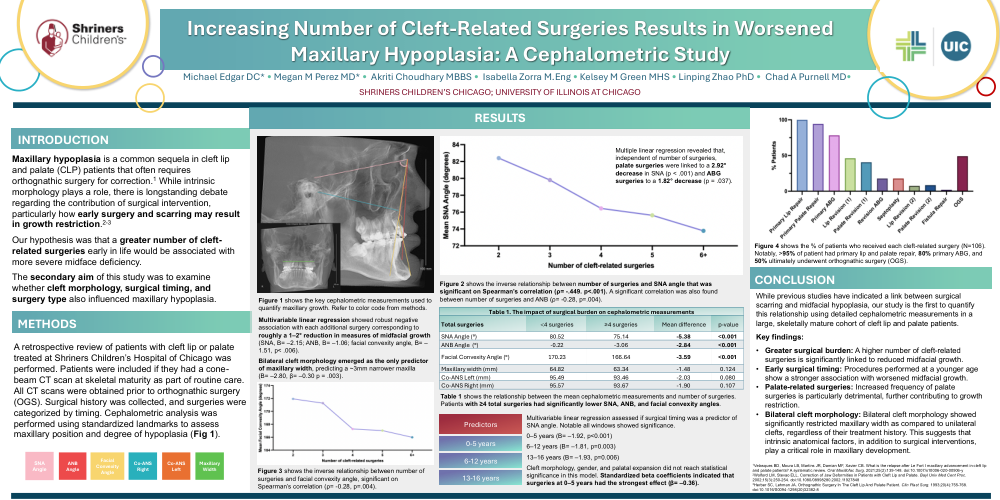
Maxillary hypoplasia is a common sequela in cleft lip and palate (CLP) patients that often requires orthognathic surgery for correction.1 While intrinsic morphology plays a role, there is longstanding debate regarding the contribution of surgical intervention, particularly how early surgery and scarring may result in growth restriction.2-3 Our hypothesis was that a greater number of cleft-related surgeries early in life would be associated with more severe midface deficiency. The secondary aim of this study was to examine whether cleft morphology, surgical timing, and surgery type also influenced maxillary hypoplasia.
A retrospective review of patients with cleft lip or palate treated at Shriners Children’s Hospital of Chicago was performed. Patients were included if they had a cone-beam CT scan at skeletal maturity as part of routine care. All CT scans were obtained prior to orthognathic surgery (OGS). Surgical history was collected, and surgeries were categorized by timing. Cephalometric analysis was performed using standardized landmarks to assess maxillary position and degree of hypoplasia.
While previous studies have indicated a link between surgical scarring and midfacial hypoplasia, our study is the first to quantify this relationship using detailed cephalometric measurements in a large, skeletally mature cohort of cleft lip and palate patients. Key findings: Greater surgical burden: A higher number of cleft-related surgeries is significantly linked to reduced midfacial growth; Early surgical timing: Procedures performed at a younger age show a stronger association with worsened midfacial growth; Palate-related surgeries: Increased frequency of palate surgeries is particularly detrimental, further contributing to growth restriction; Bilateral cleft morphology: Bilateral cleft morphology showed significantly restricted maxillary width as compared to unilateral clefts, regardless of their treatment history. This suggests that intrinsic anatomical factors, in addition to surgical interventions, play a critical role in maxillary development.