241 posters, 10 topics, 7 sessions, 899 authors, 296 institutions
ePostersLive by SciGen Technologies S.A. All rights reserved.
The AAPS 103rd Annual Meeting 2025
May 24-27, 2025 | Austin, Texas

D50
Cost And Safety Analysis Of Postoperative Admission Practices In Craniosynostosis Repair: Icu Vs. Surgical Floor.
Poster Presenter
Authors
Affiliations
Part of Topic
Craniofacial/Peds
Cost and Safety Analysis of Postoperative Admission Practices in Craniosynostosis Repair: ICU vs. Surgical Ward
Miriam Becker MS, Alvin Nguyen BA, Greta Davis, MD, Alexis MacDonald MS, Melissa Kanack MD, Benjamin Massenburg MD, Amanda Gosman MD
Background:
In the United States, most centers routinely admit pediatric patients to the intensive care unit (ICU) following craniosynostosis repair. At the authors’ institution, a paradigm shift was implemented two decades ago: direct postoperative ward admission of stable patients with non-syndromic craniosynostosis and ASA class I–II. This study evaluates the financial implications of this approach by comparing hospitalization charges for ward versus ICU admissions, including patients who required upgraded care. This topic has become increasingly relevant as minimally invasive techniques have made routine ICU admission less critical.
Methods:
A retrospective review was performed of all patients who underwent craniosynostosis repair between 2000 and 2024. ICU and ward charges were estimated based on average per-night costs from a cohort of 76 patients treated between 2014–2019, adjusted to 2024 USD. Charges reflect hospitalization costs only, excluding procedural and other fees.
Results:
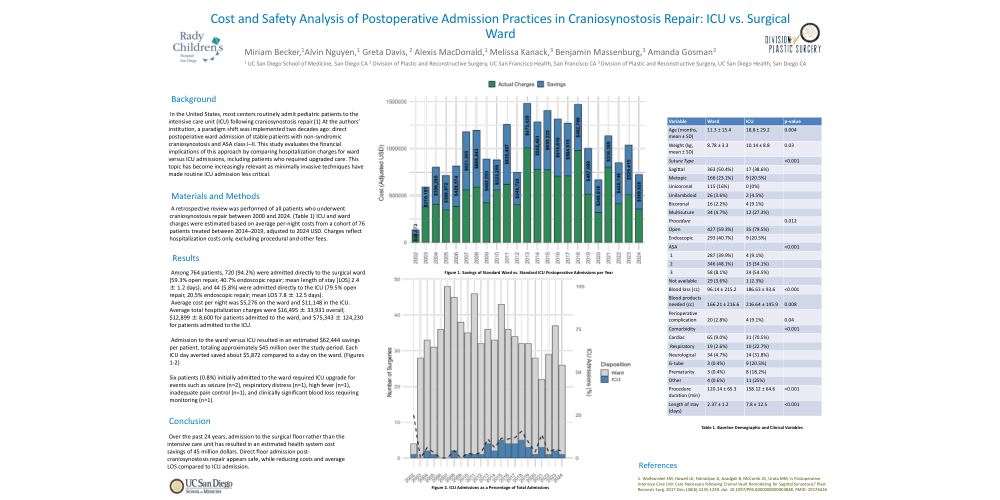
Among 764 patients, 720 (94.2%) were admitted directly to the surgical ward (59.3% open repair, 40.7% endoscopic repair; mean length of stay [LOS] 2.4 ± 1.2 days), and 44 (5.8%) were admitted directly to the ICU (79.5% open repair, 20.5% endoscopic repair; mean LOS 7.8 ± 12.5 days).
Average cost per night was $5,276 on the ward and $11,148 in the ICU. Average total hospitalization charges were $16,495 ± 33,931 overall; $12,899 ± 8,600 for patients admitted to the ward, and $75,343 ± 124,230 for patients admitted to the ICU.
Admission to the ward versus ICU resulted in an estimated $62,444 savings per patient, totaling approximately $45 million over the study period. Each ICU day averted saved about $5,872 compared to a day on the ward.
Six patients (0.8%) initially admitted to the ward required ICU upgrade for events such as seizure (n=2), respiratory distress (n=1), high fever (n=1), inadequate pain control (n=1), and clinically significant blood loss requiring monitoring (n=1).
Conclusions:
Over the past 24 years, admission to the surgical ward rather than the intensive care unit has resulted in an estimated health system cost savings of 45 million dollars. Direct ward admission post-craniosynostosis repair appears safe, while reducing costs and average LOS compared to ICU admission.