241 posters, 10 topics, 7 sessions, 899 authors, 296 institutions
ePostersLive by SciGen Technologies S.A. All rights reserved.
The AAPS 103rd Annual Meeting 2025
May 24-27, 2025 | Austin, Texas

D48
Comparing Pain Management Techniques In Children Undergoing Primary Palatoplasty: A Prospective Study
Poster Presenter
Part of Topic
Craniofacial/Peds
Comparing Pain Management Techniques In Children Undergoing Primary Palatoplasty: A Prospective Study
Kathryn R. Reisner, BA1, Anitesh Bajaj, BS2, Gabrielle C. Rodriguez, MD1, Taylor G. Hallman, BS, Jason Zhang, BS, Ariel Figueroa Baker, MD, Umer Qureshi, MEd, Parul Rai, BS, Emily George, MD, Hannah Soltani, BS, Arun Gosain, MD
Introduction:
Administering opioids to infants raises concerns about postoperative sedation, respiratory depression, and airway compromise, especially for children undergoing a primary palatoplasty.
There remains no clear consensus on the most effective method compared to the traditional practice of infiltrating the surgical site with local anesthetic.
This study evaluates whether local palatal infiltration is as effective as suprazygomatic maxillary nerve block (SMB) in minimizing postoperative pain, optimizing postoperative feeding, and expediting hospital discharge in patients undergoing primary palatoplasty.
Methods:
Participants were recruited from Ann & Robert H. Lurie Children’s Hospital, and our cohort included all patients between the ages of 2 months and 36 months undergoing primary cleft palate repair.
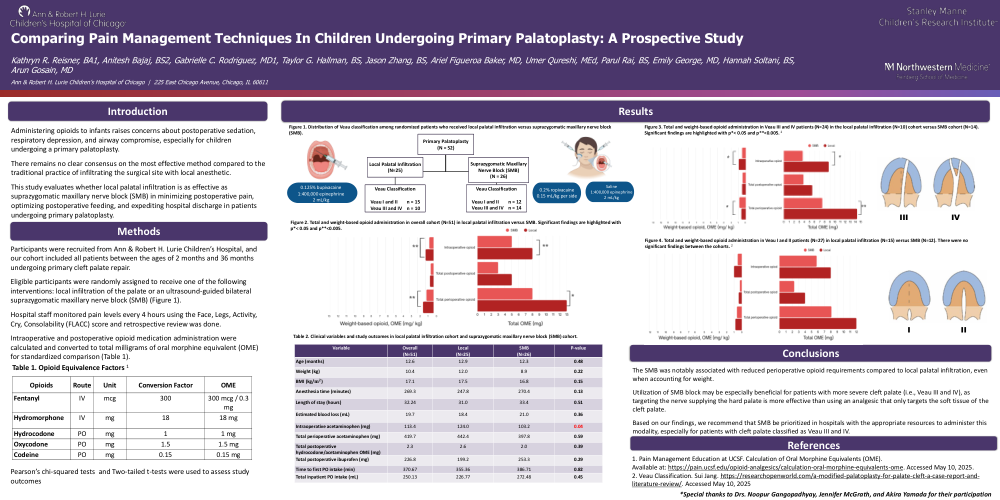
Eligible participants were randomly assigned to receive one of the following interventions: local infiltration of the palate or an ultrasound-guided bilateral suprazygomatic maxillary nerve block (SMB) (Figure 1).
Hospital staff monitored pain levels every 4 hours using the Face, Legs, Activity, Cry, Consolability (FLACC) score and retrospective review was done.
Intraoperative and postoperative opioid medication administration were calculated and converted to total milligrams of oral morphine equivalent (OME) for standardized comparison (Table 1).
Pearson’s chi-squared tests and Two-tailed t-tests were used to assess study outcomes
Results:
Conclusion:
The SMBwasnotablyassociatedwithreducedperioperativeopioidrequirements comparedtolocalpalatalinfiltration, even when accounting for weight.
Utilization of SMB block may be especially beneficial for patients with more severe cleft palate (i.e., Veau III and IV), as targeting the nerve supplying the hard palate is more effective than using an analgesic that only targets the soft tissue of the cleft palate.
Basedonourfindings,werecommend that SMB be prioritized in hospitals with the appropriate resources to administer this modality, especially for patients with cleft palate classified as Veau III and IV.