241 posters, 10 topics, 7 sessions, 899 authors, 296 institutions
ePostersLive by SciGen Technologies S.A. All rights reserved.
The AAPS 103rd Annual Meeting 2025
May 24-27, 2025 | Austin, Texas

P50
Endoscopic Strip Craniectomy Performed Earlier Than Three Months Of Age For Nonsyndromic Craniosynostosis Has Comparable Long-term Outcomes To Later Age Surgery
Poster Presenter
Part of Topic
Craniofacial/Peds
Superior Outcomes in Endoscopic Strip Craniectomy Before Three Months of Age for Nonsyndromic Craniosynostosis
Introduction
Management of all craniosynostosis (CS) is primarily surgical, including both open calvarial vault remodeling (CVR) and endoscopic strip craniectomy (ESC).4 In ESC, the fused suture is excised, and barrel staves are created, both in minimally invasive fashion such that postoperative helmet, spring, or distractor device assistance allows for more gradual remodeling.5,6
Currently, ESC is recommended for patients between 3 and 6 months of age given that rapid cranial growth and age-appropriate cranial malleability facilitate postoperative reshaping.6 However, increasing evidence suggests that surgery at even earlier ages may lead to faster deformity correction and reduced risk of neurological comorbidities.7,8 Although ESC has been successfully performed in children as young as 2 weeks of age,9 the literature supporting positive outcomes at operative ages younger than 3 months remains sparse.
Purpose
We sought to compare the perioperative and long-term outcomes of ESC performed for NSCS patients less than 3 months old vs. those for patients 3 months and older in order to assess the safety, efficacy, and potential advantages of providing earlier endoscopic intervention for NSCS management.
Methods
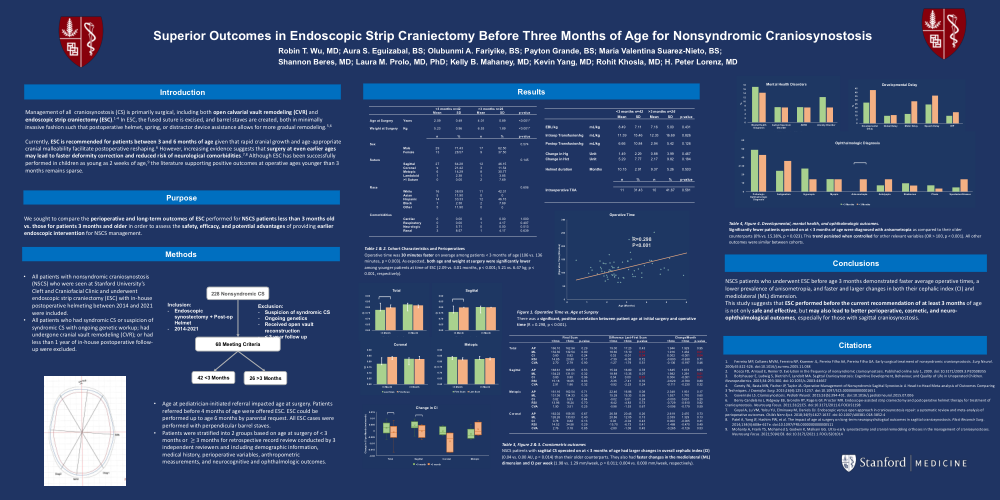
NSCS patients who underwent ESC before age 3 months demonstrated faster average operative times, a lower prevalence of anisometropia, and faster and larger changes in both their cephalic index (CI) and mediolateral (ML) dimension.
This study suggests that ESC performed before the current recommendation of at least 3 months of age is not only safe and effective, but may also lead to better perioperative, cosmetic, and neuro-ophthalmological outcomes, especially for those with sagittal craniosynostosis.