241 posters, 10 topics, 7 sessions, 899 authors, 296 institutions
ePostersLive by SciGen Technologies S.A. All rights reserved.
The AAPS 103rd Annual Meeting 2025
May 24-27, 2025 | Austin, Texas

D137
Surgical Management Algorithm For Peripheral Nerve Symptoms Following Total Knee Arthroplasty
Poster Presenter
Authors
Floris Raasveld, Otis van Varsseveld, Wen-Chih Liu, Justin McCarty, Caroline Hundepool, Michiel Zuidam, ian Valerio, Kyle Eberlin
Affiliations
Massachusetts General Hospital, Erasmus MC Rotterdam, Netherlands, Division of Plastic and Reconstructive Surgery, Massachusetts General Hospital, Harvard Medical School, Boston, MA, Department of Orthopaedic Surgery, Kaohsiung Medical University Hospital, Kaohsiung Medical University, Kaohsiung, Taiwan, Erasmus MC Rottedam, Netherlands
Part of Topic
Hand/Extremity
Neuropathic pain, weakness, and/or numbness can complicate partial or total knee arthroplasty (KA). Given the common occurrence of neuropathic pain after KA, and increasing interest of peripheral nerve surgeons in managing these symptoms, there is a need for an algorithmic approach. This study aims to evaluate the presentation, treatment, and outcomes of post-KA peripheral nerve symptoms and to propose a surgical management algorithm based on our institutional experience and a review of the literature.
Patients who underwent peripheral nerve surgery for neuropathic symptoms (neuropathic pain and/or motor dysfunction) following KA between 2012-2024 (≥3-month follow-up) were included. Demographics, comorbidities, and type of treatment were collected, and a cross-sectional survey assessed satisfaction (Patient Global Impression of Change, PGIC) and quality of life (EuroQol-5-Dimension-5-Level, EQ-5D-5L).
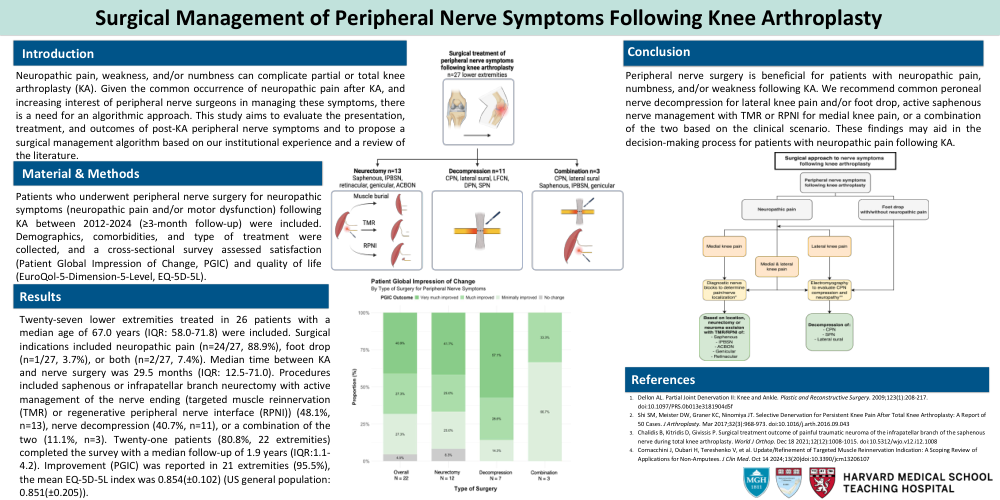
Twenty-seven lower extremities treated in 26 patients with a median age of 67.0 years (IQR: 58.0-71.8) were included. Surgical indications included neuropathic pain (n=24/27, 88.9%), foot drop (n=1/27, 3.7%), or both (n=2/27, 7.4%). Median time between KA and nerve surgery was 29.5 months (IQR: 12.5-71.0). Procedures included saphenous or infrapatellar branch neurectomy with active management of the nerve ending (targeted muscle reinnervation (TMR) or regenerative peripheral nerve interface (RPNI)) (48.1%, n=13), nerve decompression (40.7%, n=11), or a combination of the two (11.1%, n=3). Twenty-one patients (80.8%, 22 extremities) completed the survey with a median follow-up of 1.9 years (IQR:1.1-4.2). Improvement (PGIC) was reported in 21 extremities (95.5%), the mean EQ-5D-5L index was 0.854(±0.102) (US general population: 0.851(±0.205)).
Peripheral nerve surgery is beneficial for patients with neuropathic pain, numbness, and/or weakness following KA. We recommend common peroneal nerve decompression for lateral knee pain and/or foot drop, active saphenous nerve management with TMR or RPNI for medial knee pain, or a combination of the two based on the clinical scenario. These findings may aid in the decision-making process for patients with neuropathic pain following KA.