Loading...

241 posters, 10 topics, 7 sessions, 899 authors, 296 institutions

ePostersLive by SciGen Technologies S.A. All rights reserved.

The AAPS 103rd Annual Meeting 2025

May 24-27, 2025 | Austin, Texas

The AAPS 103rd Annual Meeting 2025 banner

D122

A Proof Of Concept Case Series Of Botulinum Toxin A Treatment For Ischemic Feet Due To Raynaud’S Phenomen
Part of Topic

Hand/Extremity

A Proof Of Concept Case Series Of Botulinum Toxin A Treatment For Ischemic Feet Due To Raynaud’s Phenomenon 

L.F. Stadelmeier, J.E. Eeuwen, T. Engmann, M. Göben, R. Faulhaber, L. Hilbig-Vlatten, B.J. Carroll, J. Nashel, A.S. Dowlatshahi 

1Department of Orthopaedicsurgery, Orthoplastic division, Beth Israel Deaconess Medical Center, Boston, MA

2Department of Cardiology, Harvard Medical School, Boston, MA

BACKGROUND

Raynaud's Phenomenon (RP) is a vasospastic disorder primarily impacting the hands and feet

Secondary RP can lead to severe ischemic complications like ischemia (ulceration / gangrene)

Treatment options for RP range from lifestyle adjustments to pharmacological approaches.

For resistant symptoms resulting in severe ischemia, there are two avenues: 

•surgical sympathectomy (invasive / high complication rate)
•chemical sympathectomy with Botulinum Toxin A (BTX-A), which shows potential efficacy in alleviating advanced symptoms in the hands

This case series unveils a new application of BTX-A treatment for ischemic symptoms in the foot, an approach well-documented for hands but not previously described for feet

METHODS

Data was collected retrospectively from the OMR of 7 patients who were treated with BTX-A injections for RP of the feet between 2019 and 2023, encompassing a total of 11 treatment episodes 

Collected parameters from 7 patients 

•patient demographics, prior treatments, diagnosis based on the ICD-9/10 code

Collected parameters from 11 treatment episodes

•BTX-A treatment specifics, treatment intervals, duration since last treatment, and pain using the visual analog scale (VAS)   

Follow-up after 6 weeks 

•Symptom resolution (yes/no)
•VAS-scores obtained via questionnaire and categorized into ordinal groups. Analyzed via chi-square test
•Reported side-effects

Surgical technique 

1.OR in supine position
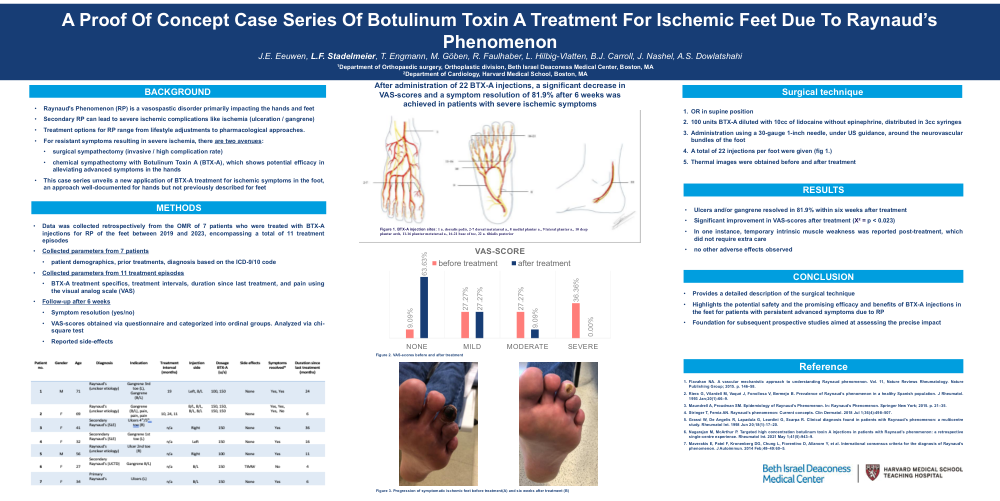
2.100 units BTX-A diluted with 10cc of lidocaine without epinephrine, distributed in 3cc syringes 
3.Administration using a 30-gauge 1-inch needle, under US guidance, around the neurovascular bundles of the foot 
4.A total of 22 injections per foot were given (fig 1.)
5.Thermal images were obtained before and after treatment

RESULTS

Ulcers and/or gangrene resolved in 81.9% within six weeks after treatment

Significant improvement in VAS-scores after treatment (X² = p < 0.023) 

In one instance, temporary intrinsic muscle weakness was reported post-treatment, which did not require extra care

no other adverse effects observed 

CONCLUSION

Provides a detailed description of the surgical technique

Highlights the potential safety and the promising efficacy and benefits of BTX-A injections in the feet for patients with persistent advanced symptoms due to RP 

Foundation for subsequent prospective studies aimed at assessing the precise impact

Reference

1.Flavahan NA. A vascular mechanistic approach to understanding Raynaud phenomenon. Vol. 11, Nature Reviews Rheumatology. Nature Publishing Group; 2015. p. 146–58. 
2.Riera G, Vilardell M, Vaqué J, Fonollosa V, Bermejo B. Prevalence of Raynaud’s phenomenon in a healthy Spanish population. J Rheumatol. 1993 Jan;20(1):66–9. 
3.Maundrell A, Proudman SM. Epidemiology of Raynaud’s Phenomenon. In: Raynaud’s Phenomenon. Springer New York; 2015. p. 21–35. 
4.Stringer T, Femia AN. Raynaud’s phenomenon: Current concepts. Clin Dermatol. 2018 Jul 1;36(4):498–507. 
5.Grassi W, De Angelis R, Lapadula G, Leardini G, Scarpa R. Clinical diagnosis found in patients with Raynaud’s phenomenon: a multicentre study. Rheumatol Int. 1998 Jun 20;18(1):17–20. 
6.Nagarajan M, McArthur P. Targeted high concentration botulinum toxin A injections in patients with Raynaud’s phenomenon: a retrospective single-centre experience. Rheumatol Int. 2021 May 1;41(5):943–9. 
7.Maverakis E, Patel F, Kronenberg DG, Chung L, Fiorentino D, Allanore Y, et al. International consensus criteria for the diagnosis of Raynaud’s phenomenon. J Autoimmun. 2014 Feb;48–49:60–5. 


aaps2025 banner
Copyright © 2015-2026, ePostersLive® SciGen is a registered trademark of SciGen Technologies S.A. Patent pending.

This website and third-party tools we use rely on cookies for the best user experience. By selecting "I agree", you agree to cookie usage as described in our Privacy Policy.