241 posters, 10 topics, 7 sessions, 899 authors, 296 institutions
ePostersLive by SciGen Technologies S.A. All rights reserved.
The AAPS 103rd Annual Meeting 2025
May 24-27, 2025 | Austin, Texas

D125
Automated Pain Sketch Classification For Lower Extremity Amputees Using Computer Vision And Machine Learning
Poster Presenter
Authors
Arya Rao, Floris Raasveld, Omar Moussa, Benjamin Johnston, Anna Luan, Zihe Zhang, Clifford Woolf, Krystle Tuano, Ian Valerio, Kyle Eberlin
Affiliations
Brigham and Women's Hospital, Division of Plastic and Reconstructive Surgery, Department of General Surgery, Massachusetts General Hospital, Harvard Medical School, Boston, MA, Stanford Medicine, Boston Children's Hospital
Part of Topic
Hand/Extremity
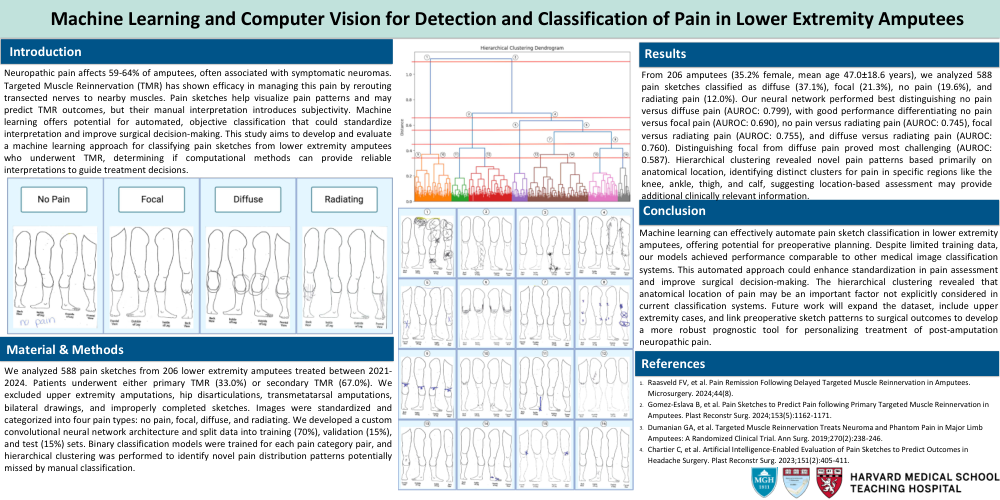
Neuropathic pain affects 59-64% of amputees, often associated with symptomatic neuromas. Targeted Muscle Reinnervation (TMR) has shown efficacy in managing this pain by rerouting transected nerves to nearby muscles. Pain sketches help visualize pain patterns and may predict TMR outcomes, but their manual interpretation introduces subjectivity. Machine learning offers potential for automated, objective classification that could standardize interpretation and improve surgical decision-making. This study aims to develop and evaluate a machine learning approach for classifying pain sketches from lower extremity amputees who underwent TMR, determining if computational methods can provide reliable interpretations to guide treatment decisions.
We analyzed 588 pain sketches from 206 lower extremity amputees treated between 2021-2024. Patients underwent either primary TMR (33.0%) or secondary TMR (67.0%). We excluded upper extremity amputations, hip disarticulations, transmetatarsal amputations, bilateral drawings, and improperly completed sketches. Images were standardized and categorized into four pain types: no pain, focal, diffuse, and radiating. We developed a custom convolutional neural network architecture and split data into training (70%), validation (15%), and test (15%) sets. Binary classification models were trained for each pain category pair, and hierarchical clustering was performed to identify novel pain distribution patterns potentially missed by manual classification.
From 206 amputees (35.2% female, mean age 47.0±18.6 years), we analyzed 588 pain sketches classified as diffuse (37.1%), focal (21.3%), no pain (19.6%), and radiating pain (12.0%). Our neural network performed best distinguishing no pain versus diffuse pain (AUROC: 0.799), with good performance differentiating no pain versus focal pain (AUROC: 0.690), no pain versus radiating pain (AUROC: 0.745), focal versus radiating pain (AUROC: 0.755), and diffuse versus radiating pain (AUROC: 0.760). Distinguishing focal from diffuse pain proved most challenging (AUROC: 0.587). Hierarchical clustering revealed novel pain patterns based primarily on anatomical location, identifying distinct clusters for pain in specific regions like the knee, ankle, thigh, and calf, suggesting location-based assessment may provide additional clinically relevant information.
Machine learning can effectively automate pain sketch classification in lower extremity amputees, offering potential for preoperative planning. Despite limited training data, our models achieved performance comparable to other medical image classification systems. This automated approach could enhance standardization in pain assessment and improve surgical decision-making. The hierarchical clustering revealed that anatomical location of pain may be an important factor not explicitly considered in current classification systems. Future work will expand the dataset, include upper extremity cases, and link preoperative sketch patterns to surgical outcomes to develop a more robust prognostic tool for personalizing treatment of post-amputation neuropathic pain.