241 posters, 10 topics, 7 sessions, 899 authors, 296 institutions
ePostersLive by SciGen Technologies S.A. All rights reserved.
The AAPS 103rd Annual Meeting 2025
May 24-27, 2025 | Austin, Texas

D135
Pediatric Gunshot Wounds Of The Upper Extremity
Poster Presenter
Part of Topic
Hand/Extremity
•Firearm injuries are the leading cause of death in children.1
•Upper extremity (UE) gunshot wounds (GSWs) can have long-term functional deficits and create significant economic burdens on victims and families.2,3
•There is a paucity of literature describing these injuries within the pediatric population, specifically regarding the upper extremity.
•The aim of our study was to determine the etiology, management, and outcomes of children presenting with UE gunshot wounds at a large academic level one pediatric hospital.
•A retrospective review of 120 patients who presented from 2011-2024 with UE GSWs was conducted following IRB approval.
•Descriptive analysis was completed.
•Key Findings:
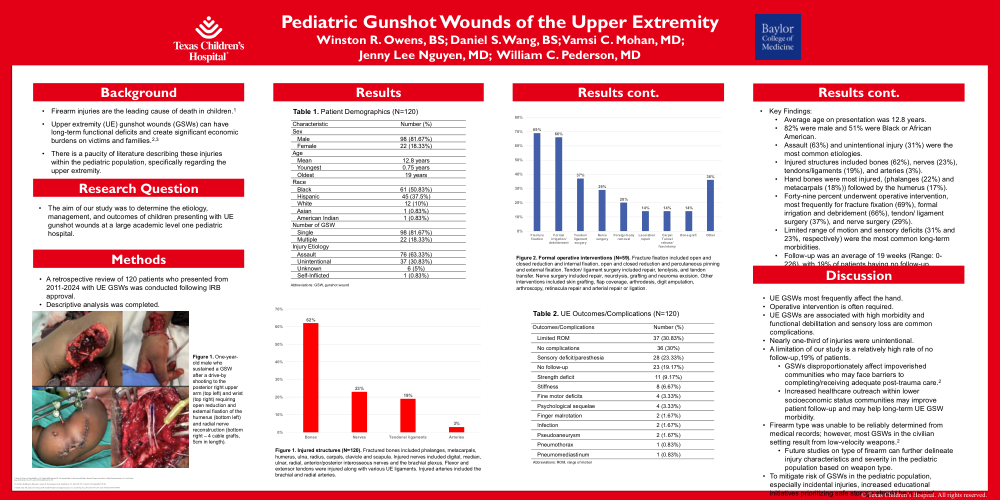
•Average age on presentation was 12.8 years.
•82% were male and 51% were Black or African American.
•Assault (63%) and unintentional injury (31%) were the most common etiologies.
•Injured structures included bones (62%), nerves (23%), tendons/ligaments (19%), and arteries (3%).
•Hand bones were most injured, (phalanges (22%) and metacarpals (18%)) followed by the humerus (17%).
•Forty-nine percent underwent operative intervention, most frequently for fracture fixation (69%), formal irrigation and debridement (66%), tendon/ ligament surgery (37%), and nerve surgery (29%).
•Limited range of motion and sensory deficits (31% and 23%, respectively) were the most common long-term morbidities.
•Follow-up was an average of 19 weeks (Range: 0-226), with 19% of patients having no follow-up.
•UE GSWs most frequently affect the hand.
•Operative intervention is often required.
•UE GSWs are associated with high morbidity and functional debilitation and sensory loss are common complications.
•Nearly one-third of injuries were unintentional.
•A limitation of our study is a relatively high rate of no follow-up,19% of patients.
•GSWs disproportionately affect impoverished communities who may face barriers to completing/receiving adequate post-trauma care.2
•Increased healthcare outreach within lower socioeconomic status communities may improve patient follow-up and may help long-term UE GSW morbidity.
•Firearm type was unable to be reliably determined from medical records; however, most GSWs in the civilian setting result from low-velocity weapons.2
•Future studies on type of firearm can further delineate injury characteristics and severity in the pediatric population based on weapon type.
•To mitigate risk of GSWs in the pediatric population, especially incidental injuries, increased educational initiatives prioritizing safe storage should be pursued.