241 posters, 10 topics, 7 sessions, 899 authors, 296 institutions
ePostersLive by SciGen Technologies S.A. All rights reserved.
The AAPS 103rd Annual Meeting 2025
May 24-27, 2025 | Austin, Texas

D132
Neuropathic Pain Following Surgery For Malignant Peripheral Nerve Sheath Tumors
Poster Presenter
Authors
Floris Raasveld, Tareq Hanna, Fernando Pacheco, Benjamin Johnston, Marcos Gonzales, Santiago A. Lozano-Calderón, Ian L Valerio, Kyle R Eberlin
Affiliations
Division of Plastic and Reconstructive Surgery, Department of General Surgery & Hand and Arm Center, Department of Orthopaedic Surgery,Massachusetts General Hospital, Harvard Medical School, Brigham and Women's Hospital, Boston, MA, Department of Orthopedic Surgery Massachusetts General Hospital, Harvard Medical School
Part of Topic
Hand/Extremity
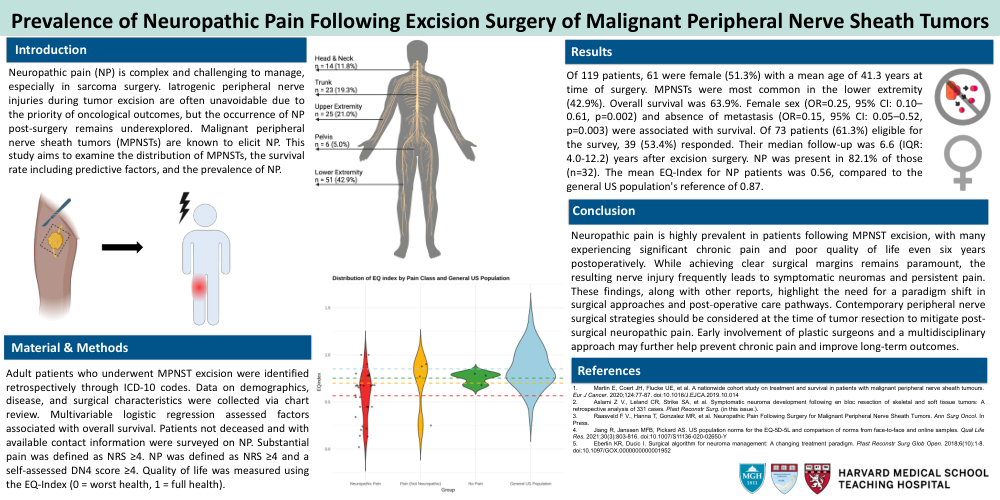
Neuropathic pain (NP) is complex and challenging to manage, especially in sarcoma surgery. Iatrogenic peripheral nerve injuries during tumor excision are often unavoidable due to the priority of oncological outcomes, but the occurrence of NP post-surgery remains underexplored. Malignant peripheral nerve sheath tumors (MPNSTs) are known to elicit NP. This study aims to examine the distribution of MPNSTs, the survival rate including predictive factors, and the prevalence of NP.
Adult patients who underwent MPNST excision were identified retrospectively through ICD-10 codes. Data on demographics, disease, and surgical characteristics were collected via chart review. Multivariable logistic regression assessed factors associated with overall survival. Patients not deceased and with available contact information were surveyed on NP. Substantial pain was defined as NRS ≥4. NP was defined as NRS ≥4 and a self-assessed DN4 score ≥4. Quality of life was measured using the EQ-Index (0 = worst health, 1 = full health).
Of 119 patients, 61 were female (51.3%) with a mean age of 41.3 years at time of surgery. MPNSTs were most common in the lower extremity (42.9%). Overall survival was 63.9%. Female sex (OR=0.25, 95% CI: 0.10–0.61, p=0.002) and absence of metastasis (OR=0.15, 95% CI: 0.05–0.52, p=0.003) were associated with survival. Of 73 patients (61.3%) eligible for the survey, 39 (53.4%) responded. Their median follow-up was 6.6 (IQR: 4.0-12.2) years after excision surgery. NP was present in 82.1% of those (n=32). The mean EQ-Index for NP patients was 0.56, compared to the general US population's reference of 0.87.
Neuropathic pain is highly prevalent in patients following MPNST excision, with many experiencing significant chronic pain and poor quality of life even six years postoperatively. While achieving clear surgical margins remains paramount, the resulting nerve injury frequently leads to symptomatic neuromas and persistent pain. These findings, along with other reports, highlight the need for a paradigm shift in surgical approaches and post-operative care pathways. Contemporary peripheral nerve surgical strategies should be considered at the time of tumor resection to mitigate post-surgical neuropathic pain. Early involvement of plastic surgeons and a multidisciplinary approach may further help prevent chronic pain and improve long-term outcomes.