241 posters, 10 topics, 7 sessions, 899 authors, 296 institutions
ePostersLive by SciGen Technologies S.A. All rights reserved.
The AAPS 103rd Annual Meeting 2025
May 24-27, 2025 | Austin, Texas

D128
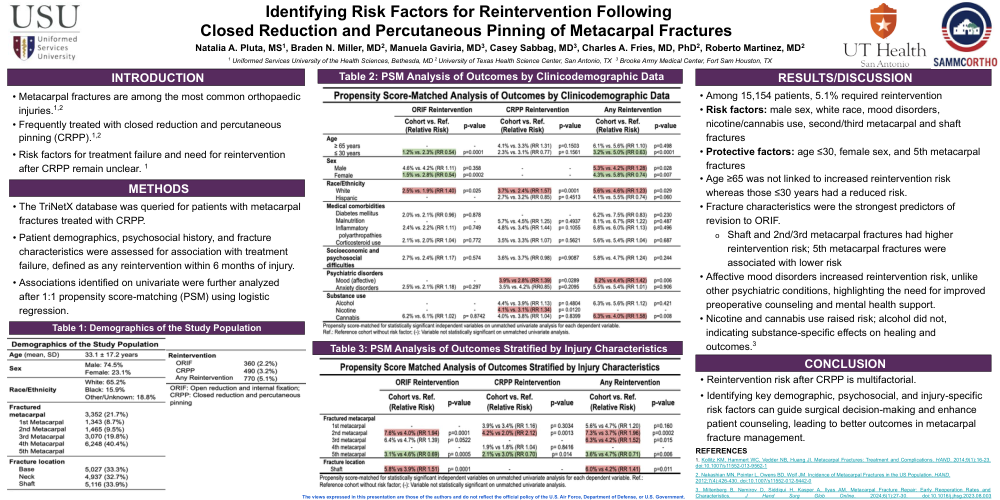
Identifying Risk Factors For Reintervention Following Closed Reduction And Percutaneous Pinning Of Metacarpal Fractures
Poster Presenter
Authors
Natalia Pluta, Braden Miller, Manuela Gaviria, Casey Sabbag, Charles Fries, Roberto Martinez
Affiliations
Uniformed Services University of the Health Sciences, Uniformed Services University of the Health Sciences, Bethesda, MD, University of Texas Health Science Center, San Antonio, TX, Brooke Army Medical Center, Fort Sam Houston, TX
Part of Topic
Hand/Extremity
INTRODUCTION:
- Metacarpal fractures are among the most common orthopaedic injuries.1,2
- Frequently treated with closed reduction and percutaneous pinning (CRPP).1,2
- Risk factors for treatment failure and need for reintervention after CRPP remain unclear. 1
METHODS
- The TriNetX database was queried for patients with metacarpal fractures treated with CRPP.
- Patient demographics, psychosocial history, and fracture characteristics were assessed for association with treatment failure, defined as any reintervention within 6 months of injury.
- Associations identified on univariate were further analyzed after 1:1 propensity score-matching (PSM) using logistic regression.
RESULTS/DISCUSSION
- Among 15,154 patients, 5.1% required reintervention
- Risk factors: male sex, white race, mood disorders, nicotine/cannabis use, second/third metacarpal and shaft fractures
- Protective factors: age ≤30, female sex, and 5th metacarpal fractures
- Age ≥65 was not linked to increased reintervention risk whereas those ≤30 years had a reduced risk.
- Fracture characteristics were the strongest predictors of revision to ORIF.
- Shaft and 2nd/3rd metacarpal fractures had higher reintervention risk; 5th metacarpal fractures were associated with lower risk
- Affective mood disorders increased reintervention risk, unlike other psychiatric conditions, highlighting the need for improved preoperative counseling and mental health support.
- Nicotine and cannabis use raised risk; alcohol did not, indicating substance-specific effects on healing and outcomes.3
CONCLUSION
- Reintervention risk after CRPP is multifactorial.
- Identifying key demographic, psychosocial, and injury-specific risk factors can guide surgical decision-making and enhance patient counseling, leading to better outcomes in metacarpal fracture management.
REFERENCES