241 posters, 10 topics, 7 sessions, 899 authors, 296 institutions
ePostersLive by SciGen Technologies S.A. All rights reserved.
The AAPS 103rd Annual Meeting 2025
May 24-27, 2025 | Austin, Texas

D64
What Matters In Primary Cleft Rhinoplasty: Anthropometric, Aesthetic, And Patient-Reported Outcomes In 482 Patients
Poster Presenter
Part of Topic
Craniofacial/Peds
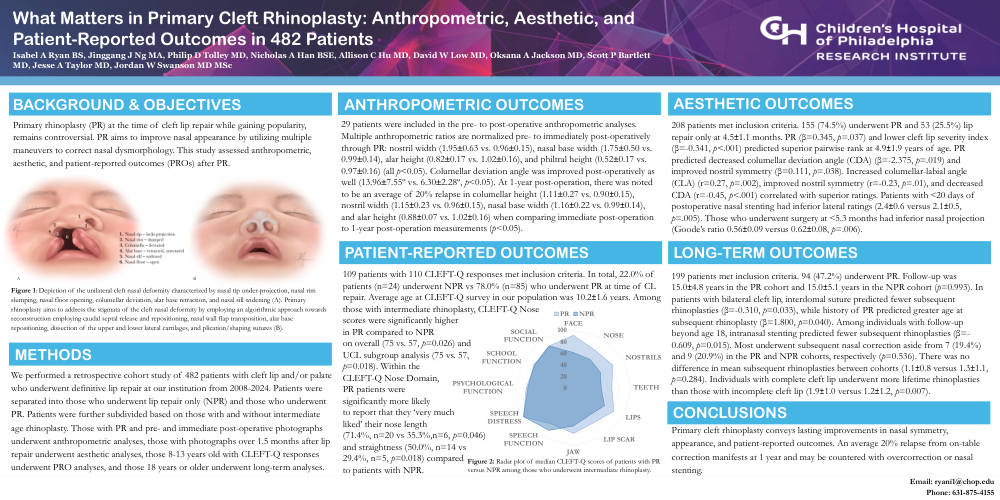
What Matters in Primary Cleft Rhinoplasty: Anthropometric, Aesthetic, and Patient-Reported Outcomes in 482 Patients
Isabel A Ryan BS,1 Jinggang J Ng MA,1 Philip D Tolley MD,1 Nicholas A Han BSE,1 Allison C Hu MD,1 David W Low MD,1 Oksana A Jackson MD,1 Scott P Bartlett MD,1 Jesse A Taylor MD,1 Jordan W Swanson MD MSc1
1Division of Plastic, Reconstructive, and Oral Surgery, Children’s Hospital of Philadelphia, Philadelphia, PA
Background & Objectives:
Primary rhinoplasty (PR) at the time of cleft lip repair while gaining popularity, remains controversial. PR aims to improve nasal appearance by utilizing multiple maneuvers to correct nasal dysmorphology. This study assessed anthropometric, aesthetic, and patient-reported outcomes (PROs) after PR.
Methods:
We performed a retrospective cohort study of 482 patients with cleft lip and/or palate who underwent definitive lip repair at our institution from 2008-2024. Patients were separated into those who underwent lip repair only (NPR) and those who underwent PR. Patients were further subdivided based on those with and without intermediate age rhinoplasty. Those with PR and pre- and immediate post-operative photographs underwent anthropometric analyses, those with photographs over 1.5 months after lip repair underwent aesthetic analyses, those 8-13 years old with CLEFT-Q responses underwent PRO analyses, and those 18 years or older underwent long-term analyses.
Anthropometric Outcomes:
29 patients were included in the pre- to post-operative anthropometric analyses. Multiple anthropometric ratios are normalized pre- to immediately post-operatively through PR: nostril width (1.95±0.63 vs. 0.96±0.15), nasal base width (1.75±0.50 vs. 0.99±0.14), alar height (0.82±0.17 vs. 1.02±0.16), and philtral height (0.52±0.17 vs. 0.97±0.16) (all p<0.05). Columellar deviation angle was improved post-operatively as well (13.96±7.55º vs. 6.30±2.28º, p<0.05). At 1-year post-operation, there was noted to be an average of 20% relapse in columellar height (1.11±0.27 vs. 0.90±0.15), nostril width (1.15±0.23 vs. 0.96±0.15), nasal base width (1.16±0.22 vs. 0.99±0.14), and alar height (0.88±0.07 vs. 1.02±0.16) when comparing immediate post-operation to 1-year post-operation measurements (p<0.05).
Patient-Reported Outcomes:
109 patients with 110 CLEFT-Q responses met inclusion criteria. In total, 22.0% of patients (n=24) underwent NPR vs 78.0% (n=85) who underwent PR at time of CL repair. Average age at CLEFT-Q survey in our population was 10.2±1.6 years. Among those with intermediate rhinoplasty, CLEFT-Q Nose scores were significantly higher in PR compared to NPR on overall (75 vs. 57, p=0.026) and UCL subgroup analysis (75 vs. 57, p=0.018). Within the CLEFT-Q Nose Domain, PR patients were significantly more likely to report that they ‘very much liked’ their nose length (71.4%, n=20 vs 35.3%, n=6, p=0.046) and straightness (50.0%, n=14 vs 29.4%, n=5, p=0.018) compared to patients with NPR.
Aesthetic Outcomes:
208 patients met inclusion criteria. 155 (74.5%) underwent PR and 53 (25.5%) lip repair only at 4.5±1.1 months. PR (β=0.345, p=.037) and lower cleft lip severity index (β=-0.341, p<.001) predicted superior pairwise rank at 4.9±1.9 years of age. PR predicted decreased columellar deviation angle (CDA) (β=-2.375, p=.019) and improved nostril symmetry (β=0.111, p=.038). Increased columellar-labial angle (CLA) (r=0.27, p=.002), improved nostril symmetry (r=-0.23, p=.01), and decreased CDA (r=-0.45, p<.001) correlated with superior ratings. Patients with ˂20 days of postoperative nasal stenting had inferior lateral ratings (2.4±0.6 versus 2.1±0.5, p=.005). Those who underwent surgery at ˂5.3 months had inferior nasal projection (Goode’s ratio 0.56±0.09 versus 0.62±0.08, p=.006).
Long-Term Outcomes:
199 patients met inclusion criteria. 94 (47.2%) underwent PR. Follow-up was 15.0±4.8 years in the PR cohort and 15.0±5.1 years in the NPR cohort (p=0.993). In patients with bilateral cleft lip, interdomal suture predicted fewer subsequent rhinoplasties (β=-0.310, p=0.033), while history of PR predicted greater age at subsequent rhinoplasty (β=1.800, p=0.040). Among individuals with follow-up beyond age 18, intranasal stenting predicted fewer subsequent rhinoplasties (β=-0.609, p=0.015). Most underwent subsequent nasal correction aside from 7 (19.4%) and 9 (20.9%) in the PR and NPR cohorts, respectively (p=0.536). There was no difference in mean subsequent rhinoplasties between cohorts (1.1±0.8 versus 1.3±1.1, p=0.284). Individuals with complete cleft lip underwent more lifetime rhinoplasties than those with incomplete cleft lip (1.9±1.0 versus 1.2±1.2, p=0.007).
Conclusions:
Primary cleft rhinoplasty conveys lasting improvements in nasal symmetry, appearance, and patient-reported outcomes. An average 20% relapse from on-table correction manifests at 1 year and may be countered with overcorrection or nasal stenting.