241 posters, 10 topics, 7 sessions, 899 authors, 296 institutions
ePostersLive by SciGen Technologies S.A. All rights reserved.
The AAPS 103rd Annual Meeting 2025
May 24-27, 2025 | Austin, Texas

D62
Public Perceptions Of Positional Plagiocephaly
Poster Presenter
Part of Topic
Craniofacial/Peds
Public Perceptions of Positional Plagiocephaly
Background
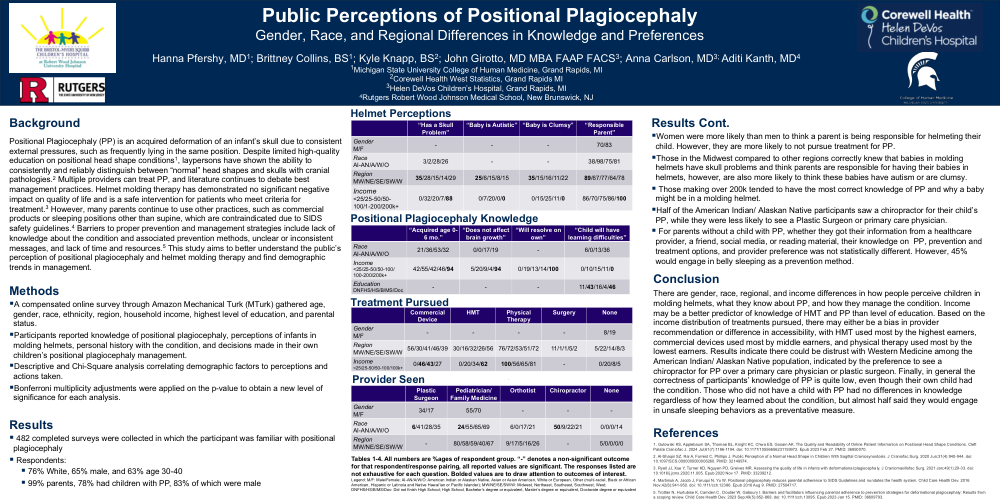
Positional Plagiocephaly (PP) is an acquired deformation of an infant's skull due to consistent external pressures, such as frequently lying in the same position. Despite limited high-quality education on positional head shape conditions1, laypersons have shown the ability to consistently and reliably distinguish between "normal" head shapes and skulls with cranial pathologies.2 Multiple providers can treat PP, and literature continues to debate best management practices. Helmet molding therapy has demonstrated no significant negative impact on quality of life and is a safe intervention for patients who meet criteria for
treatment.3 However, many parents continue to use other practices, such as commercialproducts or sleeping positions other than supine, which are contraindicated due to SIDS safety guidelines.4 Barriers to proper prevention and management strategies include lack of knowledge about the condition and associated prevention methods, unclear or inconsistent messages, and lack of time and resources.5 This study aims to better understand the public's perception of positional plagiocephaly and helmet molding therapy and find demographic trends in management.
Methods
▪A compensated online survey through Amazon Mechanical Turk (MTurk) gathered age, gender, race, ethnicity, region, household income, highest level of education, and parental status.
▪Participants reported knowledge of positional plagiocephaly, perceptions of infants in molding helmets, personal history with the condition, and decisions made in their own children’s positional plagiocephaly management.
▪Descriptive and Chi-Square analysis correlating demographic factors to perceptions and actions taken.
▪Bonferroni multiplicity adjustments were applied on the p-value to obtain a new level of significance for each analysis.
Results
▪ 482 completed surveys were collected in which the participant was familiar with positional
plagiocephaly
▪ Respondents: 76% White, 65% male, and 63% age 30-40, 99% parents, 78% had children with PP, 83% of which were male
▪Women were more likely than men to think a parent is being responsible for helmeting their child. However, they are more likely to not pursue treatment for PP.
▪Those in the Midwest compared to other regions correctly knew that babies in moldinghelmets have skull problems and think parents are responsible for having their babies in helmets, however, are also more likely to think these babies have autism or are clumsy.
▪ Those making over 200k tended to have the most correct knowledge of PP and why a baby might be in a molding helmet.
▪Half of the American Indian/ Alaskan Native participants saw a chiropractor for their child’s PP, while they were less likely to see a Plastic Surgeon or primary care physician.
▪ For parents without a child with PP, whether they got their information from a healthcare provider, a friend, social media, or reading material, their knowledge on PP, prevention and treatment options, and provider preference was not statistically different. However, 45% would engage in belly sleeping as a prevention method.
Conclusion
There are gender, race, regional, and income differences in how people perceive children in molding helmets, what they know about PP, and how they manage the condition. Income may be a better predictor of knowledge of HMT and PP than level of education. Based on the income distribution of treatments pursued, there may either be a bias in provider recommendation or difference in accessibility, with HMT used most by the highest earners,commercial devices used most by middle earners, and physical therapy used most by the lowest earners. Results indicate there could be distrust with Western Medicine among the American Indian/ Alaskan Native population, indicated by the preference to see a chiropractor for PP over a primary care physician or plastic surgeon. Finally, in general the correctness of participants’ knowledge of PP is quite low, even though their own child had the condition. Those who did not have a child with PP had no differences in knowledge regardless of how they learned about the condition, but almost half said they would engage in unsafe sleeping behaviors as a preventative measure.
References
1. Gutowski KS, Applebaum SA, Thomae BL, Knight KC, Chwa ES, Gosain AK. The Quality and Readability of Online Patient Information on Positional Head Shape Conditions. Cleft Palate Craniofac J. 2024 Jul;61(7):1186-1194. doi: 10.1177/10556656231159972. Epub 2023 Feb 27. PMID: 36850070.
2. Al-Shaqsi SZ, Rai A, Forrest C, Phillips J. Public Perception of a Normal Head Shape in Children With Sagittal Craniosynostosis. J Craniofac Surg. 2020 Jun;31(4):940-944. doi:10.1097/SCS.0000000000006260. PMID: 32149974.
3. Ryall JJ, Xue Y, Turner KD, Nguyen PD, Greives MR. Assessing the quality of life in infants with deformational plagiocephaly. J Craniomaxillofac Surg. 2021 Jan;49(1):29-33. doi:10.1016/j.jcms.2020.11.005. Epub 2020 Nov 17. PMID: 33239212.
4. Martiniuk A, Jacob J, Faruqui N, Yu W. Positional plagiocephaly reduces parental adherence to SIDS Guidelines and nundates the health system. Child Care Health Dev. 2016Nov;42(6):941-950. doi: 10.1111/cch.12386. Epub 2016 Aug 9. PMID: 27504717.
5. Trottier N, Hurtubise K, Camden C, Cloutier W, Gaboury I. Barriers and facilitators influencing parental adherence to prevention strategies for deformational plagiocephaly: Results from a scoping review. Child Care Health Dev. 2023 Sep;49(5):852-869. doi: 10.1111/cch.13095. Epub 2023 Jan 15. PMID: 36609793.