241 posters, 10 topics, 7 sessions, 899 authors, 296 institutions
ePostersLive by SciGen Technologies S.A. All rights reserved.
The AAPS 103rd Annual Meeting 2025
May 24-27, 2025 | Austin, Texas

D59
Multifactorial Analysis Of Dental Implant Success In Irradiated Fibular Free Flaps: A 7-year Head And Neck Cancer Cohort Study
Poster Presenter
Part of Topic
Craniofacial/Peds
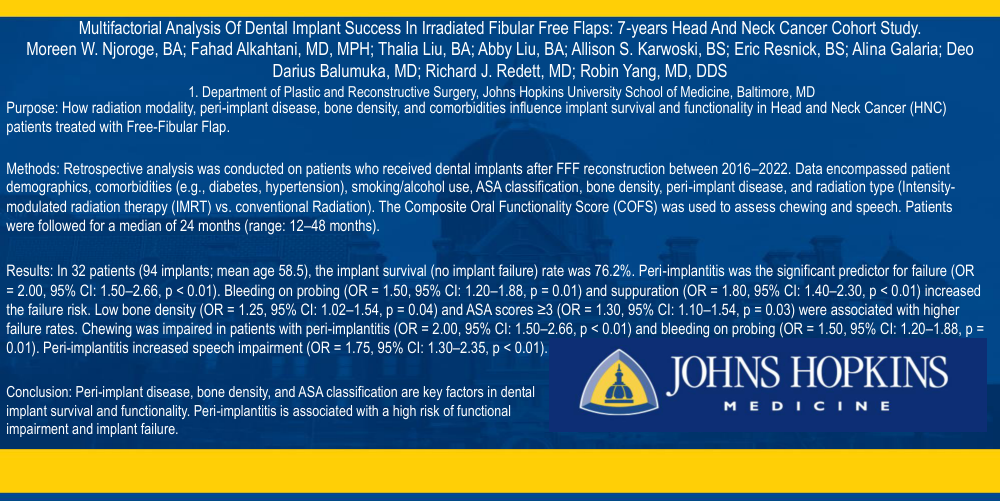
Multifactorial Analysis Of Dental Implant Success In Irradiated Fibular Free Flaps: 7-years Head And Neck Cancer Cohort Study.
Moreen W. Njoroge, BA; Fahad Alkahtani, MD, MPH; Thalia Liu, BA; Abby Liu, BA; Allison S. Karwoski, BS; Eric Resnick, BS; Alina Galaria; Deo Darius Balumuka, MD; Richard J. Redett, MD; Robin Yang, MD, DDS
1. Department of Plastic and Reconstructive Surgery, Johns Hopkins University School of Medicine, Baltimore, MD
Purpose: How radiation modality, peri-implant disease, bone density, and comorbidities influence implant survival and functionality in Head and Neck Cancer (HNC) patients treated with Free-Fibular Flap.
Methods: Retrospective analysis was conducted on patients who received dental implants after FFF reconstruction between 2016–2022. Data encompassed patient demographics, comorbidities (e.g., diabetes, hypertension), smoking/alcohol use, ASA classification, bone density, peri-implant disease, and radiation type (Intensity-modulated radiation therapy (IMRT) vs. conventional Radiation). The Composite Oral Functionality Score (COFS) was used to assess chewing and speech. Patients were followed for a median of 24 months (range: 12–48 months).
Results: In 32 patients (94 implants; mean age 58.5), the implant survival (no implant failure) rate was 76.2%. Peri-implantitis was the significant predictor for failure (OR = 2.00, 95% CI: 1.50–2.66, p < 0.01). Bleeding on probing (OR = 1.50, 95% CI: 1.20–1.88, p = 0.01) and suppuration (OR = 1.80, 95% CI: 1.40–2.30, p < 0.01) increased the failure risk. Low bone density (OR = 1.25, 95% CI: 1.02–1.54, p = 0.04) and ASA scores ≥3 (OR = 1.30, 95% CI: 1.10–1.54, p = 0.03) were associated with higher failure rates. Chewing was impaired in patients with peri-implantitis (OR = 2.00, 95% CI: 1.50–2.66, p < 0.01) and bleeding on probing (OR = 1.50, 95% CI: 1.20–1.88, p = 0.01). Peri-implantitis increased speech impairment (OR = 1.75, 95% CI: 1.30–2.35, p < 0.01).
Conclusion: Peri-implant disease, bone density, and ASA classification are key factors in dental
implant survival and functionality. Peri-implantitis is associated with a high risk of functional
impairment and implant failure.