241 posters, 10 topics, 7 sessions, 899 authors, 296 institutions
ePostersLive by SciGen Technologies S.A. All rights reserved.
The AAPS 103rd Annual Meeting 2025
May 24-27, 2025 | Austin, Texas

D53
Disparities In Access To Endoscopic And Open Approaches To The Surgical Management Of Craniosynostosis: A Large, National Cohort Evaluation
Poster Presenter
Part of Topic
Craniofacial/Peds
Disparities in Access to Endoscopic and Open Approaches to the Surgical Management of Craniosynostosis: A Large, National Cohort Evaluation
Daniel Y. Kwon, BS1; Allison Choe, BS1; Dillan F. Villavisanis, MD1; Olachi Oleru, MD1; Nargiz Seyidova, MD1; Peter Shamamian, BS1; Carol Wang, BA1; Alex Sarosi, MD1; Peter Taub, MD, MS1
1.Division of Plastic and Reconstructive Surgery, Icahn School of Medicine, New York, New York
Background:
•Craniosynostosis is a congenital condition with potential long-term neurodevelopmental consequences.
•Endoscopic repair offers a minimally invasive alternative to traditional open surgery but requires early intervention (before 3–6 months of age).
•Timely access to care is often limited for socioeconomically and racially marginalized populations.
•Delays in diagnosis and referral may result in exclusion from endoscopic repair despite clinical eligibility.
•This study investigates demographic, socioeconomic, and institutional factors influencing access to endoscopic vs. open repair using a national inpatient dataset.
Methods:
Design: Retrospective cohort study using the Healthcare Cost and Utilization Project (HCUP) National Inpatient Sample (2018–2021).
Population: Pediatric patients undergoing craniosynostosis repair stratified into endoscopic vs. open surgery.
Variables:
Design: Retrospective cohort study using the Healthcare Cost and Utilization Project (HCUP) National Inpatient Sample (2018–2021).
Population: Pediatric patients undergoing craniosynostosis repair stratified into endoscopic vs. open surgery.
Variables:
•Demographics (age, sex, race/ethnicity).
•Socioeconomic indicators (insurance type, zip-code income quartile).
•Hospital characteristics (bed size, ownership, teaching status).
Results:
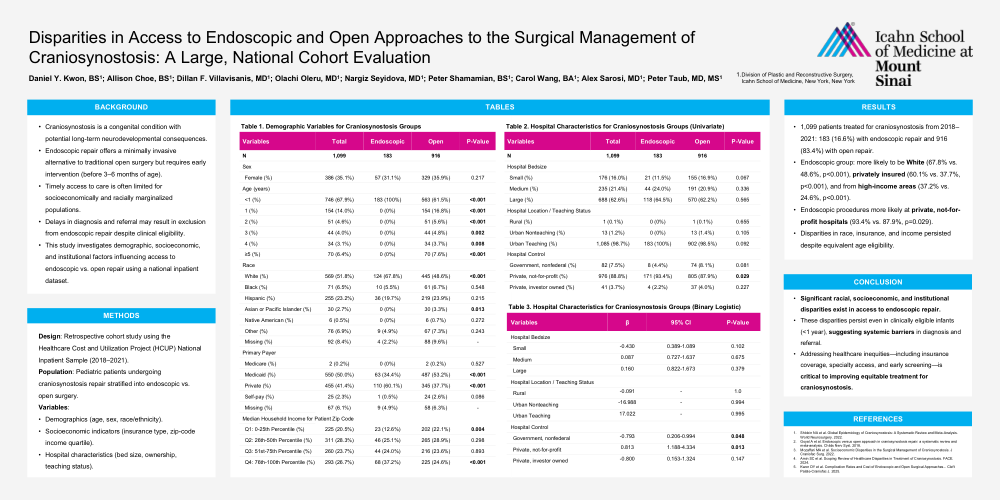
•1,099 patients treated for craniosynostosis from 2018–2021: 183 (16.6%) with endoscopic repair and 916 (83.4%) with open repair.
•Endoscopic group: more likely to be White (67.8% vs. 48.6%, p<0.001), privately insured (60.1% vs. 37.7%, p<0.001), and from high-income areas (37.2% vs. 24.6%, p<0.001).
•Endoscopic procedures more likely at private, not-for-profit hospitals (93.4% vs. 87.9%, p=0.029).
•Disparities in race, insurance, and income persisted despite equivalent age eligibility.
Conclusion:
•Significant racial, socioeconomic, and institutional disparities exist in access to endoscopic repair.
•These disparities persist even in clinically eligible infants (<1 year), suggesting systemic barriers in diagnosis and referral.
•Addressing healthcare inequities—including insurance coverage, specialty access, and early screening—is critical to improving equitable treatment for craniosynostosis.
References
1.Shlobin NA et al. Global Epidemiology of Craniosynostosis: A Systematic Review and Meta-Analysis. World Neurosurgery. 2022.
2.Goyal A et al. Endoscopic versus open approach in craniosynostosis repair: a systematic review and meta-analysis. Childs Nerv Syst. 2018.
3.Mozaffari MA et al. Socioeconomic Disparities in the Surgical Management of Craniosynostosis. J Craniofac Surg. 2022.
4.Amin SC et al. Scoping Review of Healthcare Disparities in Treatment of Craniosynostosis. FACE. 2024.
5.Kwon DY et al. Complication Rates and Cost of Endoscopic and Open Surgical Approaches... Cleft Palate-Craniofac J. 2025.