241 posters, 10 topics, 7 sessions, 899 authors, 296 institutions
ePostersLive by SciGen Technologies S.A. All rights reserved.
The AAPS 103rd Annual Meeting 2025
May 24-27, 2025 | Austin, Texas

P13
Comparative Analysis Of Acellular Dermal Matrices As A Vehicle For Stem Cell Therapy Delivery
Part of Topic
Basic Science Research
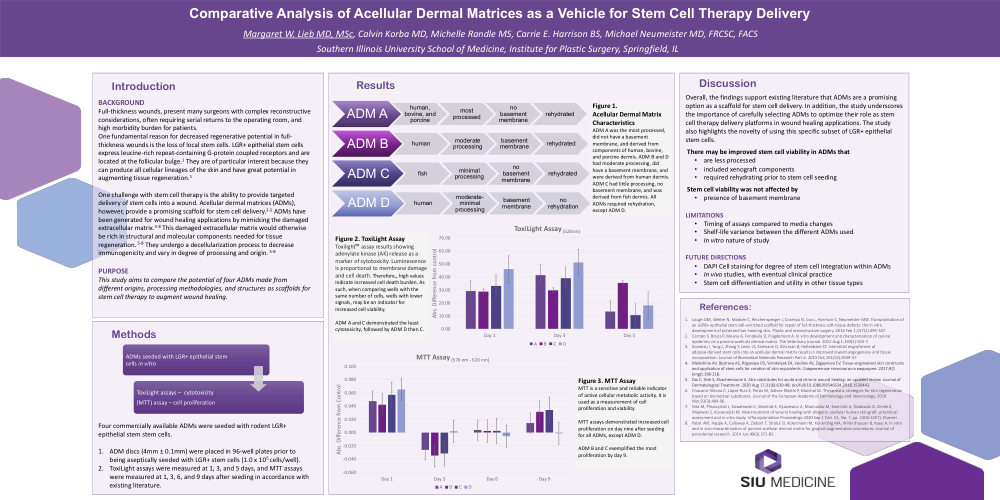
Comparative Analysis of Acellular Dermal Matrices as a Vehicle for Stem Cell Therapy Delivery
Margaret W. Lieb MD, MSc, Calvin Korba MD, Michelle Randle MS, Carrie E. Harrison BS, Michael Neumeister MD, FRCSC, FACS
Southern Illinois University School of Medicine, Institute for Plastic Surgery, Springfield, IL
INTRODUCTION
BACKGROUND
Full-thickness wounds, present many surgeons with complex reconstructive considerations, often requiring serial returns to the operating room, and high morbidity burden for patients.
One fundamental reason for decreased regenerative potential in full-thickness wounds is the loss of local stem cells. LGR+ epithelial stem cells express leucine-rich repeat-containing G-protein coupled receptors and are located at the follicular bulge.1They are of particular interest because they can produce all cellular lineages of the skin and have great potential in augmenting tissue regeneration.1
One challenge with stem cell therapy is the ability to provide targeted delivery of stem cells into a wound. Acellular dermal matrices (ADMs), however, provide a promising scaffold for stem cell delivery.2-5 ADMs have been generated for wound healing applications by mimicking the damaged extracellular matrix.5-8 This damaged extracellular matrix would otherwise be rich in structural and molecular components needed for tissue regeneration. 5-8 They undergo a decellularization process to decrease immunogenicity and vary in degree of processing and origin. 5-8
PURPOSE
This study aims to compare the potential of four ADMs made from different origins, processing methodologies, and structures as scaffolds for stem cell therapy to augment wound healing.