241 posters, 10 topics, 7 sessions, 899 authors, 296 institutions
ePostersLive by SciGen Technologies S.A. All rights reserved.
The AAPS 103rd Annual Meeting 2025
May 24-27, 2025 | Austin, Texas

D19
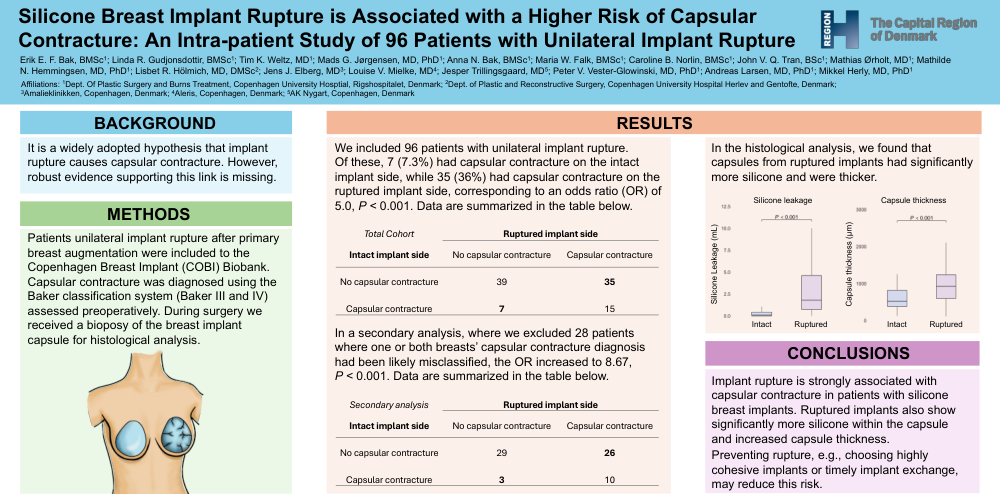
Silicone Breast Implant Rupture Is Associated With A Higher Risk Of Capsular Contracture: An Intra-patient Study Of 96 Patients With Unilateral Implant Rupture
Poster Presenter
Authors
Erik E. F. Bak, Linda R. Gudjonsdottir, Tim K. Weltz, Mads G. Jørgensen, Anna N. Bak, Maria W. Falk, Caroline B. Norlin, John V. Q. Tran, Mathias Ørholt, Mathilde N. Hemmingsen, Lisbet R. Hölmich, Jens J. Elberg, Louise V. Mielke, Jesper Trillingsgaard, Peter V. Vester-Glowinski, Andreas Larsen, Mikkel Herly
Affiliations
Copenhagen University Hospital, Rigshospitalet, Dept. Of Plastic Surgery and Burns Treatment, Copenhagen University Hosptial, Rigshospitalet, Denmark, Dept. of Plastic and Reconstructive Surgery, Copenhagen University Hospital Herlev and Gentofte, Denmark, Amalieklinikken, Copenhagen, Denmark, Aleris, Copenhagen, Denmark, AK Nygart, Copenhagen, Denmark
Part of Topic
Basic Science Research
Silicone Breast Implant Rupture is Associated with a Higher Risk of Capsular Contracture: An Intra-patient Study of 96 Patients with Unilateral Implant Rupture
BACKGROUND
It is a widely adopted hypothesis that implant rupture causes capsular contracture. However, robust evidence supporting this link is missing.
METHODS
Patients unilateral implant rupture after primary breast augmentation were included to the Copenhagen Breast Implant (COBI) Biobank. Capsular contracture was diagnosed using the Baker classification system (Baker III and IV) assessed preoperatively. During surgery we received a bioposy of the breast implant capsule for histological analysis.
RESULTS
We included 96 patients with unilateral implant rupture. Of these, 7 (7.3%) had capsular contracture on the intact implant side, while 35 (36%) had capsular contracture on the ruptured implant side, corresponding to an odds ratio (OR) of 5.0, P < 0.001. In a secondary analysis, where we excluded 28 patients where one or both breasts’ capsular contracture diagnosis had been likely misclassified, the OR increased to 8.67, P < 0.001.
In the histological analysis, we found that capsules from ruptured implants had significantly more silicone and were thicker.
CONCLUSIONS
Implant rupture is strongly associated with capsular contracture in patients with silicone breast implants. Ruptured implants also show significantly more silicone within the capsule and increased capsule thickness.
Preventing rupture, e.g., choosing highly cohesive implants or timely implant exchange, may reduce this risk.